09 August 2013

Everest Base Camp Trek - Day 8: I finally reach Base Camp!

To read all posts on my Everest Base Camp trek, click here for the complete series.


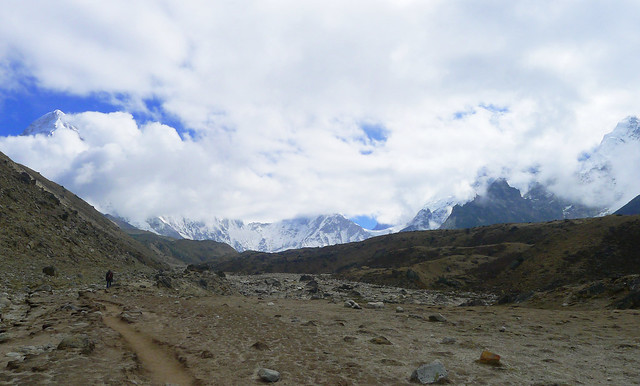
Everest Base Camp trek: the road out of Lobuche
Cloudy day. The trek from Lobuche to Everest Base Camp started okay, but would progressively get harder as the day wore on.

Day 8: June 5, 2013

Normally on my birthday, I would wake up to the sound of my phone incessantly beeping, with people greeting me on SMS or on Facebook. Or my younger sisters would be waking me up by leaping onto the bed and yelling out, "Happy Birthday!"

On my 33rd birthday, in Lobuche, I woke up to an eerily quiet morning with the sun's rays entering through the windows of my cold, tiny room. It was a strange feeling. I stayed in bed for a little while longer, absorbing the fact that I was now 33 and that I would be climbing up to Everest Base Camp that same day.  I wanted to reach EBC very, very badly, and it felt like it was the birthday gift that would make me work the hardest to deserve.

Sadly enough, I couldn't get a bath on my birthday (of all days!), so once more I had to resort to my best friend--a huge pack of antibacterial wet wipes. As I dressed, I moved my phone to a spot in the room that had some mobile signal.  And then all the SMS notifications started coming in. They were a mix of birthday greetings and of concerned messages from people asking me if I was still alive.

At breakfast, Madan and Dhan Kumar were there to greet me a happy birthday with amiable smiles and in their typically gentle Nepalese tone of voice--so different from my sisters' grand attempts to wake up the neighbors with their loud birthday greetings.

The plan that day was to trek for two hours from Lobuche to Gorak Shep (elevation: 5,160 meters / 16,929 feet), have lunch, and then trek for 2-3 hours more to Everest Base Camp.  After EBC, we would head back to Gorak Shep and stay there for the night.

For obvious reasons, this was going to be a day I would never forget. The moment we left the basic comforts of our Lobuche teahouse, I was instantly swallowed up by the wilderness. Extremely thin air, cold wind, fog, some rain, rocky trails--you name it, I got it all on my birthday.

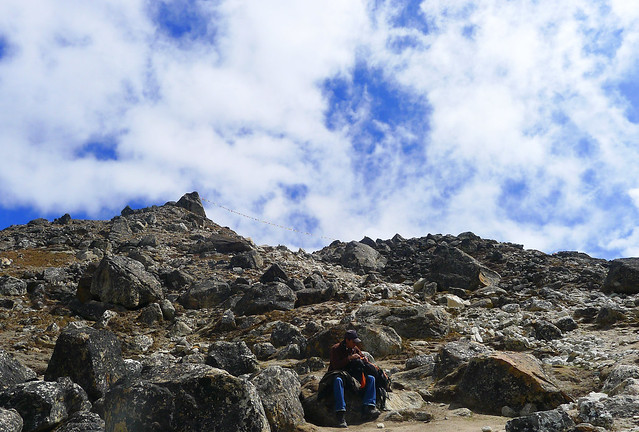
the uphill path to Gorak Shep
This hill looks small but it took more than 1 hour to climb to the top due to the altitude.
The air was getting thinner and thinner and every gasp of breath was precious. Worse, I learned that day from trail guides we encountered on the path that two trekkers had died very recently and never made it to base camp.  One was a 22-year-old female (I never got to know what her nationality was) who reached only as far as Lobuche and had to be rushed down to Pheriche due to severe altitude sickness. But by then, it was way too late for her. The other trekker was a 25-year-old Malaysian man, who also fell ill at Lobuche and died shortly thereafter--a full day before I had arrived there.

I was distraught. Two casualties--and very young people at that--already within this short span of time. I remembered the group of strong Malaysians I was with on the plane to Lukla, and I wondered if the 25-year-old was part of that group and if they had gone up the trail too fast without much acclimatization--leaving one dead and apparently another person in their group critically ill.

Now that I was on my eight trekking day, I was bone-tired and just ready to complete what I had set out to do. I hadn't expected such terrible news on my birthday, but instead of freaking out in a major way, I just turned to my guide and porter and said almost wearily, "I don't want to die on my birthday. Let's just make it to Base Camp safely and without any rush, please."

Of course, I was lucky to have such supportive companions who watched over me constantly. As we negotiated the uphill, windy path to Gorak Shep, I made sure to take it easy. On the slopes of a difficult hill, I ran into the Chinese trekker I met back in Dingboche.  He was beaming as he shook hands with me; he had reached Everest Base Camp yesterday, and said it was beautiful. I was relieved to see a familiar, friendly face in the cold wilderness and was almost reluctant to see him leave as he bade me farewell and wished me luck.

By the time we reached Gorak Shep, I was ready to collapse. In my breathless, exhausted state, I couldn't believe that I needed to trek three more hours to Everest Base Camp and another three on the way back. Lunch at Gorak Shep was vegetable fried rice, and I could only eat one-thirds of my meal. My appetite was completely f*cked up at this point, and I had to practically force-feed myself. I wouldn't have even been surprised anymore if Madan or Dhan Kumar had started shoving the rice into my mouth, because we all knew we had to massively carbo-load for the 3-hour ordeal ahead.

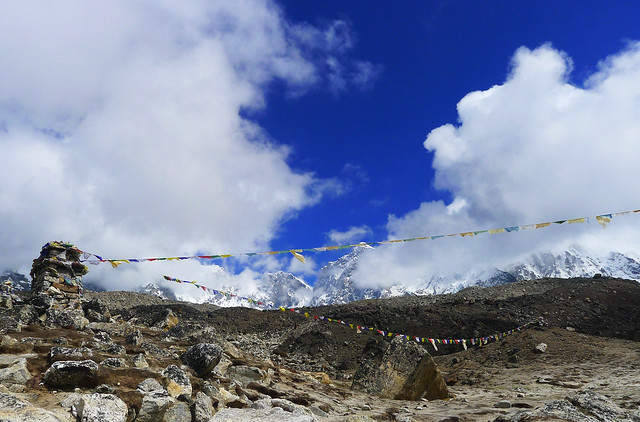
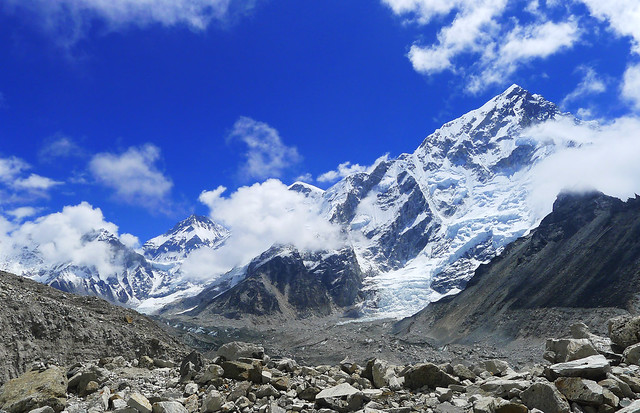
The Himalayas
The great Himalayas right before me
The path from Gorak Shep to Everest Base Camp was difficult--and rightfully so. Just like in the books and in the movies, it only made sense that the most challenging part of any journey would be the very last stretch. Those three lonely hours in that barren wasteland were unforgettable. I kept my head slightly down to block off the wind, and I just concentrated on putting one foot ahead of the other. One, two, one, two, one two, I counted numbly in my head. By then, conversation amongst the three of us had whittled down to utter silence, and I was lost in my own thoughts as I shuffled up the path.

I normally walk fast in my country, but here, at more than 5,000 meters above sea level in a climate so foreign to me, I was walking uphill at the pace of a 60-year-old--yet my heart was pounding like I was running 5 minutes per kilometer. I was alarmed at the beating of my heart, and forced myself to breathe regularly even though I felt I couldn't fill up my lungs anymore because of the thin air.  We passed stunningly beautiful glaciers, and every 10 minutes or so, we would hear a booming sound. Rocks were falling from nearby hills and mountains. It was terrifying. On that barren path with the jagged, icy peaks of the Himalayas surrounding us, I had never felt so small and insignificant in my life.

Finally, we came across these massive rock boulders that we had to scramble over, and Madan said we were very near. Well, this trek sure never made anything easy, even in the last eight minutes before reaching base camp.

As I crossed and entered Everest Base Camp territory, Madan and Dhan Kumar were standing there with smiles on their faces. They had been to EBC countless of times--so this particular day meant hardly anything to them--but I knew they were happy for me. I wasn't the type to throw my trekking poles into the air and scream in pure joy that I've made it. I just stood still and enjoyed that moment of triumph quietly. I even patted the general area where my scar is--a small tradition I always carry out every time I accomplish something major physically. Profound relief coursed through my body as I drew yet another ragged breath and said to myself, "Well, that's that. I've finally done it."

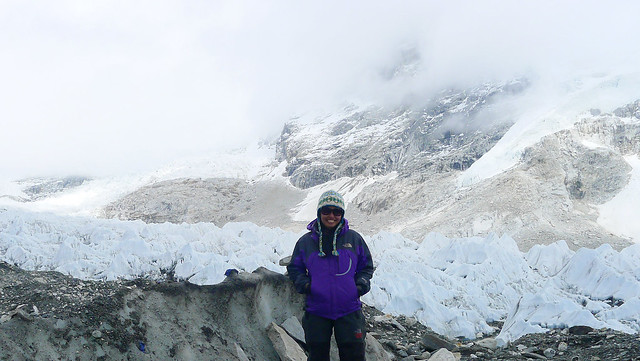
I finally reach Everest Base Camp
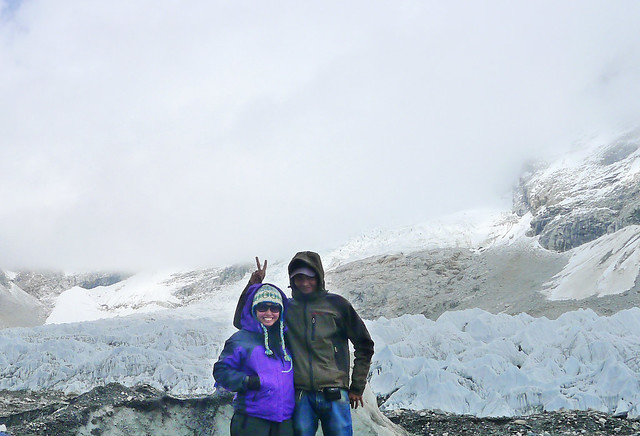
I finally reach Everest Base Camp! Elevation: 5,364 meters (17,598 feet) above sea level
Everest Base Camp was desolate and treacherous-looking with no other signs of life. No camping tents, no prayer flags, since the yearly expedition to the summit of Mt. Everest only takes place around May. For the rest of the year, the camp is usually bare. It is a place that is terribly beautiful to behold during the monsoon season: a barren, rocky land with swirling mists, the clouds lying so low, and with no sound save for the wind and our voices. It is quite deadly, with only around 50 percent available oxygen in its atmosphere compared with that of sea level; at the summit of Mt. Everest, oxygen supply level is only at one-thirds.

I had not expected the Khumbu Icefall to be so near, yet there it was--a mass of treacherous, jagged ice right in front of me leading all the way up and disappearing into the clouds where my eyes could not follow. The Khumbu Icefall is the first stretch that any Everest summitter normally encounters, and it is one of the deadliest, most technical aspects of a summit expedition on this south side of Everest (the northern one being on the Tibet side). The path is hardly ever the same, as glaciers move over time--more so when the sun is out and the ice melts inch by inch--thus making the Khumbu Icefall a dangerous, unpredictable path to cross.

After taking in my surroundings, I broke into a huge smile and called out, "Hey, Dhan Kumar, remember your promise?"

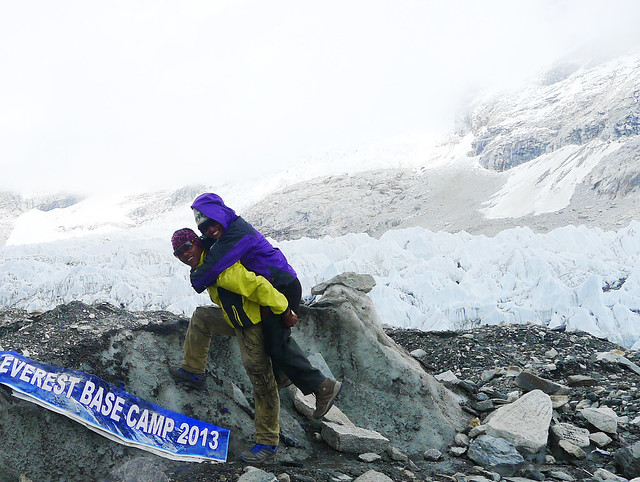
Early in the trek (on day 3 in Kyanjuma I think), Dhan Kumar and I had struck a deal. If I made it to Everest Base Camp safe and sound, we would have our picture taken together--that of him carrying me on his back. And so Madan stood there, ready to take the long-awaited photo. I laughed delightedly as Dhan Kumar bent slightly backwards and hauled me effortlessly up onto his back.  We were in a fit of hysterics by then, and it was a miracle my porter had not dropped me. It actually hurt to laugh, given the limited oxygen in the air.

And then it was time for my photo with Madan, whose presence I'm always grateful for. He literally and mentally kept me alive on the trail, with his great guiding skills, his jokes, and his mischievous card-dealing tricks.

with my porter Dhan Kumar at Everest Base Camp
It was very windy and abysmally cold, but we still had a great time at Everest Base Camp. With my Sherpa porter Dhan Kumar.

with my guide Madan at Everest Base Camp
With Madan, my guide and constant companion on the trail to Everest Base Camp 
I had finally achieved what I wanted to do after months of preparation, which was to reach Everest on my birthday. I may not have been the fastest, the strongest or the fittest trekker, but I had done it. And I had the most wonderful companions to thank for, for making the journey less difficult with their friendship and the endless laughs we shared.

If Everest Base Camp were easy, everyone else would have made it there. But it isn't easy at all--as most hard-earned goals are meant to be--and the ones who do make it are not necessarily the ultra athletic type. I've heard real stories of these super trekkers--young and incredibly fit--who had been forced to turn back before reaching Base Camp because their bodies couldn't handle it. High altitude affects everyone in different ways, and I felt proud that I had gone this far physically and mentally, armed with my usual determination (or stubbornness?) and a natural disposition to endure anything thrown my way.

Horribly cliched as it sounds, it is true nevertheless: the whole experience really was not just about the destination but also in the journey getting there. And as I made my way back to Gorak Shep for another 3-hour trek, I knew Everest had given me a lifetime of getting-there memories to keep.

* * *

If you want the same Everest Base Camp trek experience I had, visit Himalayan Planet Adventures and go for the 16-day Everest Base Camp trek package.


30 July 2013

Everest Base Camp Trek - Day 7: Dugla Pass and the Trek to Lobuche

To read all posts on my Everest Base Camp trek, click here for the complete series.


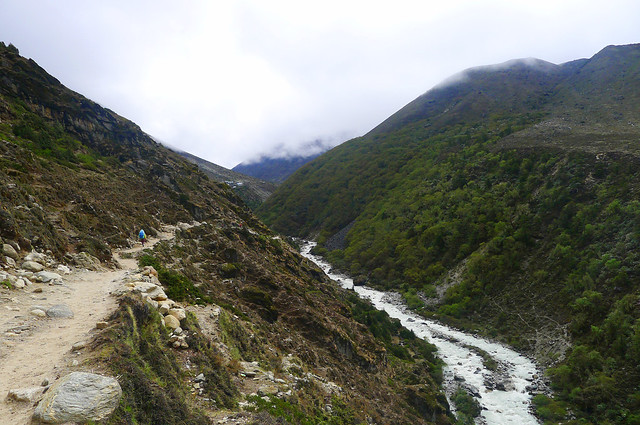
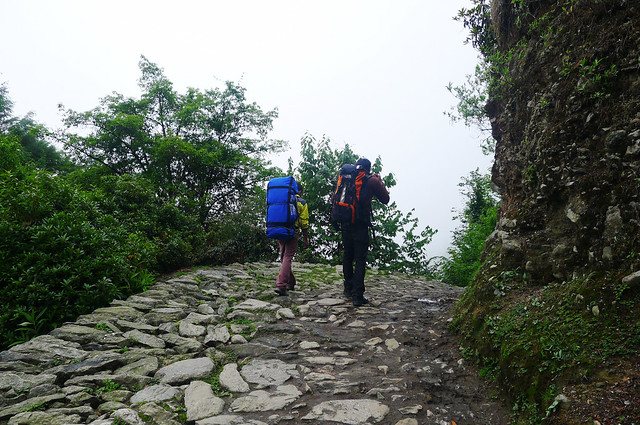
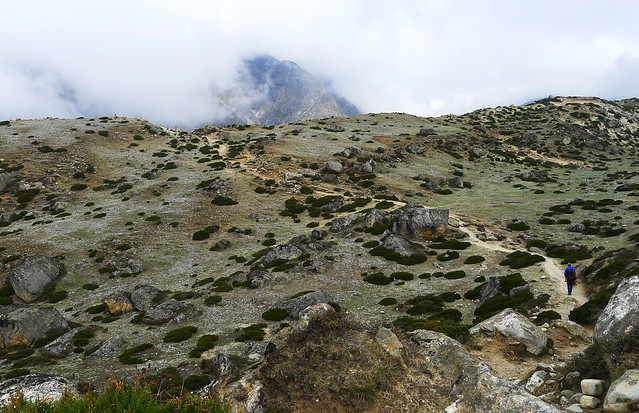
on the trail to Everest Base Camp
The beautiful paths situated between Dingboche and Lobuche. My guide Madan is the blue figure on the right.


Day 7: June 4, 2013

I decided to start the day right with a bucket shower.

I don't know about other trekkers, but I would not have been able to survive the whole 12 days without a single bath.  I am simply not programmed to give up any precious opportunity to have a shower. During this trek, I've been lucky so far to be staying in teahouses where the common toilets are situated inside, and not in outhouses that would require you to run out into the brutally cold night with headlamps on to answer the call of nature. (This also has a lot to do with how good your trek agency is in reserving teahouse rooms for you, and I feel lucky that Himalayan Planet Adventures always made sure I had a good bed and decent toilet waiting for me at the end of each trekking day.) And I was also able to shower 8 out of the 12 days on the trail, which ain't pretty bad!

A bucket shower, I was to learn, is different from a gas shower--the latter being quite a luxury and practically non-existent this high up on the trail. The bucket shower, while very basic, has its charms.

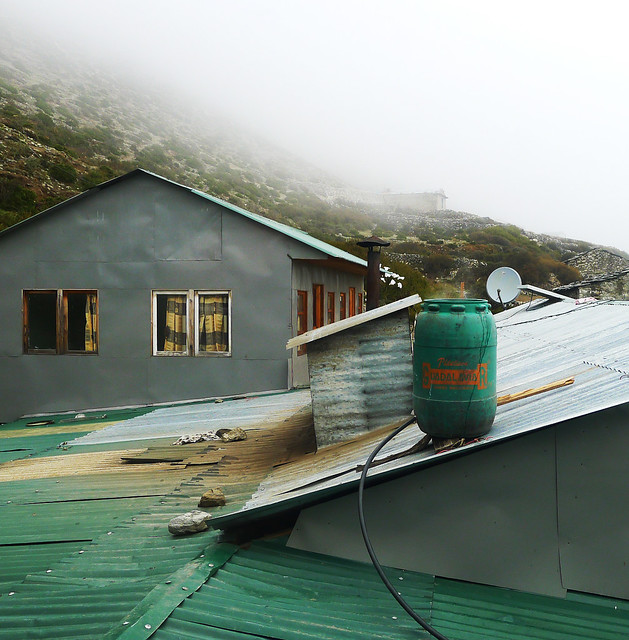
Nepalese bucket shower at Dingboche
The amazing bucket shower -- Nepali-style
My bucket shower at the Dingboche teahouse consists of this contraption: a huge water drum on top of the teahouse roof with a hose connecting it to a shower head inside the common bathroom. Someone from the teahouse heats up water from the yak stove, carries the hot water buckets up to the roof, and fills up the water drum. All I need to do is switch on a valve inside the shower room and there you have it--hot water flowing from the water drum and right out of the shower head. It's really and truly a bucket shower! Quite ingenious and worth the price of 500 Nepalese rupees (USD 5-6). The rest of the world--especially in areas with no running water--stand to learn a lot from the Nepalis.  I simply had to tell my UNICEF colleagues in the Water, Sanitation and Hygiene Section back in Manila about the bucket shower.

I breakfasted on milk porridge (otherwise known as oatmeal!) and hot chocolate that day.  For the next few days until I returned to Kathmandu, I could not stomach anything else in the morning except oatmeal and hot chocolate. And I could never, ever finish my breakfast. Madan, ever the watchful guide, had this sort of disapproving look on his face every time I pushed away my bowl of barely eaten milk porridge; he would remind me that I needed energy to keep me going through the trek. What could I do, my appetite has failed me, I'd always say. I could only manage, at best, a few spoonfuls of oatmeal and a small cup of hot chocolate.

I had also gone without coffee for days, which was difficult and mind-blowing for a coffee addict like me.  I had to actually stop drinking coffee around Day 3 because it was contributing to the palpitations I was already feeling high up on the trail. High altitude + coffee is a disaster waiting to happen.

We left Dingboche at 9:00 am, and even with the cold and mist, it was still a pleasant walking experience. The road to Thukla, our lunch stop, involved a green hilly landscape that eased my trek-weary state a little. But even with the easy rolling path, I had to stop walking every 10 minutes or so to catch my breath. The air was getting too thin for comfort.

Five minutes away from Thukla, we had to cross this horribly makeshift bridge of uneven rocks right above the river. Some parts were rocks, a short stretch involved thin rickety planks, and then there was some wire wrapped around the rocks to keep these steady and from eroding. Trip on those wires and you might end up falling into the river.

I wasn't able to take a photo of this bridge because I was, uh, busy keeping my balance and trying not to scream in terror. I've borrowed a photo of this Thukla bridge from another blog just to give you folks an idea of what the bridge looked like. (It really looks scarier in real life, to be honest.). Special thanks to Kwok Yeen Cheah of Outdoors Malaysia, who also writes about his Everest Base Camp experience.

Bridge at Thukla. Photo Credit: Kwok Yeen Cheah, Outdoors Malaysia (2012)

I thought the bridge was going to be the highlight of Day 7, but the Himalayas had more in store for me apparently. After lunch, I went through what I felt was one of the toughest uphills I've ever encountered. It was the same brand of misery I felt on Day 2, and the climb to the top of the hill is something I can't forget.

I was stopping every two minutes during that climb to gasp and breathe in lungfuls of air. It didn't help that my nose was terribly clogged and it hurt to blow my nose all the time. The difficulty of that afternoon's walk had nothing to do with the terrain, which looked like your typical rocky hill with some steep inclines. But the altitude level had gotten so bad that no matter how I tried to fill up my lungs, I realized to my dismay that not much air was flowing in. And I had actually thought that the air back in Dingboche was already thin to begin with.

The cold and the thin air left me numb. I was on auto pilot, dragging my feet up the hill and regulating my breathing as best as I could. It reached the point where I was solely, desperately focusing on breathing in, breathing out while my arms and legs went through the automated motions of working the trekking poles and climbing up the path. Nothing else mattered to me except the sound of my attempts to breathe evenly. I thought about all those hours I spent in the 40-degree heated bikram yoga studio back in Manila, doing all those breathing sessions--and I fervently thanked all my yoga instructors then and there for teaching me how to breathe properly.

Dhan Kumar had gone way ahead and I was to see him later after a few hours. I asked Madan to stay in front of me, as always, because I relied on him to show me the path amidst the fog that was enveloping us on all sides on that hill. Because there was no energy left for talking during that excruciating climb that took more than an hour, I just concentrated on breathing.  When I stopped along the path to take a break and blow my nose, I would allow myself the most banal of thoughts, like if something bad happened to me, I'd probably never find out how Holmes cheated death in his fall in Sherlock's Season 2. I also wondered, fleetingly, how the rest of the world was reacting, now that HBO's Game of Thrones had just aired the Red Wedding episode a few days ago--and if it was as graphic as the scene in the novel.

When I finally made it to the top, Madan was waiting for me by this long rock ledge that was momentarily blocking out most of the wind. I gladly sat down beside him to take in more breaths of air (which was barely there) and take stock of my surroundings.  What I saw sent a little chill to my heart.

memorials for Everest summiteers
At Dugla Pass, a place full of memorials for those who died on Everest
There, on top of that hill, in the swirling mist, was a graveyard of sorts. The place is called Dugla Pass, and it was where many of the memorials are placed in honor of those who summitted Everest and died shortly thereafter. It was depressing to wander about and read the epitaphs--sobering reminders of how deadly and treacherous Mount Everest can be.

memorials for Everest summiteers
One of the many memorials at Dugla Pass
It was only 3:00 pm, yet the fog and dark sky that day made us feel that we needed to hurry along and reach Lobuche as soon as possible. Mercifully enough, the next one and a half hours was spent on a rocky, yet relatively flat expanse of land. Dhan Kumar, always with a boyish smile on his face regardless of the weather and surroundings, came back for us and took my day pack even though I was not having a hard time with it. In fact, anything after that climb up to Dugla Pass felt like a breeze.

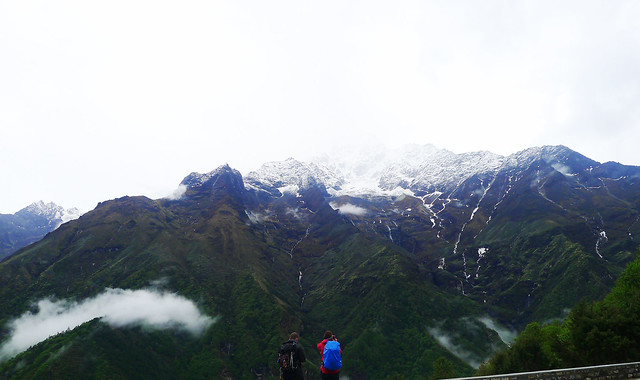
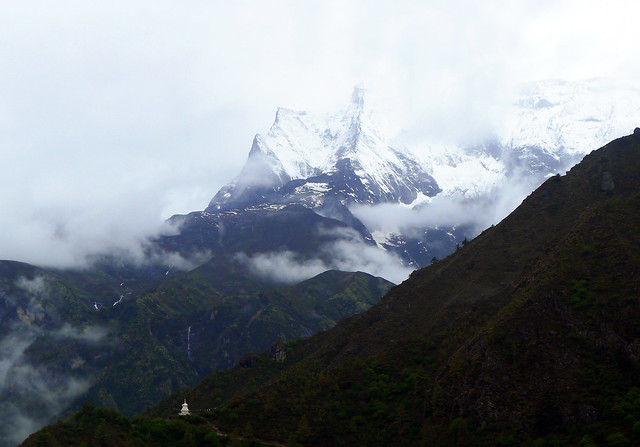
As we neared the little town of Lobuche, I was treated to wonderful views of Mounts Nuptse, Kangtega and Thamserku--beautiful and majestic mountains in their own right yet sadly dwarfed by the ever popular Everest.  I said a little prayer of thanks for getting through yet another challenging day.  And no matter how hard a day's trek would be, the sight of the Himalayan mountains always thrilled me to the core.

We arrived in Lobuche (elevation: 4,928 meters / 16,164 feet) at 4:30 pm, with enough time to rest, eat dinner, and prepare for the big day tomorrow--Everest Base Camp on my 33rd birthday.

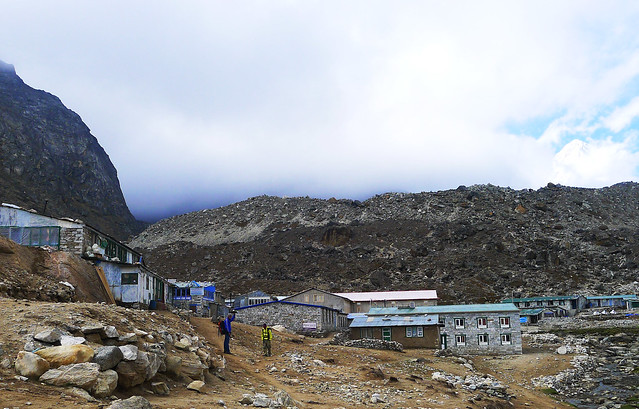
Everest Base Camp Trek: arriving at Lobuche
Yes, this small settlement is the entire area of Lobuche already. Elevation: 4,928 m / 16,164 ft.

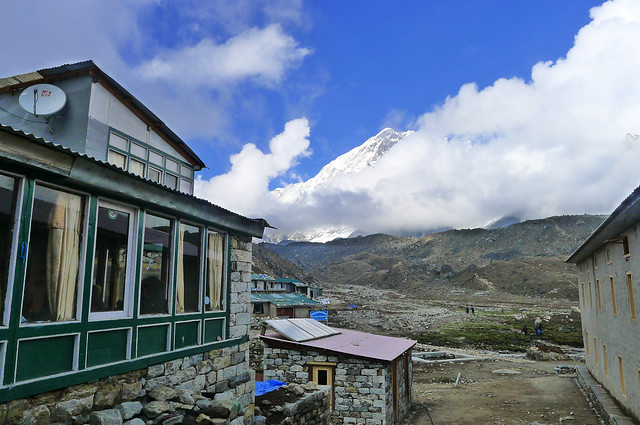
Everest Base Camp Trek: Lobuche
My view from my room at the Lobuche teahouse
* * *

If you want the same Everest Base Camp trek experience I had, visit Himalayan Planet Adventures and go for the 16-day Everest Base Camp trek package.


23 July 2013

Everest Base Camp Trek - Days 5-6: Acclimatizing in Dingboche

To read all posts on my Everest Base Camp trek, click here for the complete series.


Dingboche on the way to Everest Base Camp
O Little Town of Dingboche - Photo by Gina Sales, 2013
Day 5: June 2, 2013

Today did not turn out to be so difficult as I had expected. Or perhaps, by the fifth day on the trail, I may have had become trek-hardened already.

Whatever. As if.

The 'medium' headache was completely gone that morning, and I happily breakfasted on hot chocolate and apple pancakes--which I still could not finish. (I swear, people who want to lose weight may seriously consider climbing the Himalayas; one can barely eat anything at such high altitude.)

I had also taken a gas shower early that morning at the Pangboche teahouse, so I was feeling squeaky clean and chipper.  Gas shower, when I first heard about it, sounded like something really awful (think Holocaust!) but it's just the casual term that Nepalis use when referring to an LPG tank-powered water heater connected to a shower head.  For the price of 300 Nepalese rupees, or around 3 US dollars, a gas shower at a temperature of around 40-42 degrees Celsius in such cold weather was marvelous.

As I ate, I was on the phone with Naba, who wanted an update on my condition; he was glad to know that I was doing much better compared to last night. However, since I was heading for Dingboche that day, it meant I would be going past the 4,000-meter elevation mark. Naba was advising me to be more and more attuned to my body's response to the high altitude and to take greater precautions. After all, reaching 4,000 meters and above (13,123 ft+) was no laughing matter anymore.

Everest Base Camp: the trail from Pangboche to Dingboche
The scenic trail from Pangboche to Dingboche. Dhan Kumar ahead, as always.
The three of us walked at a good pace, starting at 8:30 am. The first two hours of the trek were pure sunshine and good wind. The itinerary indicated it would be a 4 to 5-hour trek from Pangboche to Dingboche. Days 5 and 6 would be my favorites in the trek simply because of the good weather and the fact that I was feeling a whole lot better, thanks to Diamox.

Sure, Diamox made me pee like crazy, and it caused a bit of numbness on the toes and tingling sensations at the tips of my fingers. Those were the expected side effects anyway. But anything that made me sleep well at night and helped improve my breathing pattern in order to adjust well to the altitude was certainly welcome. I was deathly afraid of getting those headaches again.

The road to Dingboche is a good one--not too hard yet not that entirely easy as well.  Struggled a bit with the altitude but at least it was not a huge problem for me that day.  We reached Dingboche (elevation: 4,358 meters / 14,295 feet) at 1:00 pm, just less than 5 hours of walking, as promised by the itinerary and just in time for lunch.

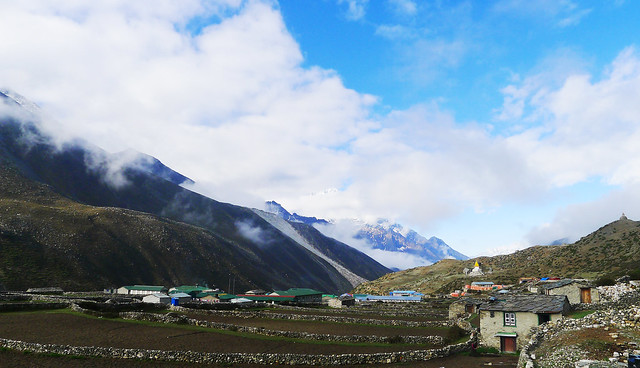
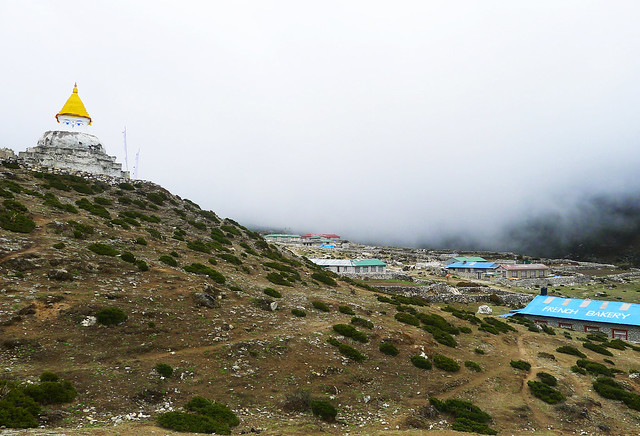
Dingboche is a lovely little farming village settlement with rolling grasslands as well as stone walls separating crops like barley and potatoes. A white stupa with a bright yellow top and a big bungalow with the words 'French Bakery' charmingly written on its roof were the first ones to greet me. I felt at home in Dingboche right away.

arriving at Dingboche
Arriving at Dingboche. Home sweet home for the next one and a half  days.
Lunch was macaroni with garlic and creamy yak cheese. These Sherpas sure know how to cook. The rest of the afternoon was spent trying to stay awake.  The teahouse was quiet, with very few guests in it. I met there three French Canadians traveling together and a solo trekker from China. I chatted with them a bit and found out that they had been in Dingboche for two days now and would all be heading up to Lobuche the next day. I, on the other hand, had to stay behind and complete the required acclimatization or 'rest' day in Dingboche.

To while away the time, I started reading Jon Krakauer's Into Thin Air, which is probably what every trekker has inside his or her day pack while on the Everest Base Camp trail. It is a gripping autobiographical account of the disastrous 1996 Everest summit expedition. The book is sure to make you feel that your base camp trek problems are much smaller compared to what that expedition group faced at the summit.

Played cards with Madan and Dhan Kumar as usual, until it was lights out for us at 9:00 pm.  Because the teahouse was solar-powered, the use of electricity was limited in the evenings, and we had to manage with our headlamps on at night while in our rooms or on the way to the toilet.


Day 6: June 3, 2013

Woke up at 5:30 am, disoriented. For a moment, I thought I was back home in Manila.

Today promised to be an easy day because I would just be resting at Dingboche. But 'resting' is such a misnomer in the Himalayas. There is no such thing as a real rest day. I still had to peel myself off the bed, get out of my clean sleepwear, and don the same dirty hiking pants that I'd been using since Day 1. And let's not forget the morning cleansing ritual via wet wipes, shall we.

Rest Day on the Everest trek actually meant 'Get Out of the Cozy Teahouse and Acclimatize by Climbing Some Difficult Hill' Day.

The road up the said steep hill was actually right outside our teahouse in Dingboche. Since it was just a short half-day trek (2 hours going all the way up, and 30 minutes going down), there was no need for Dhan Kumar to join. At least he could stay in his own warm bed and have a true blue, honest-to-goodness rest day, while I had to suck it up and hit the trail at 9 o'clock that morning.

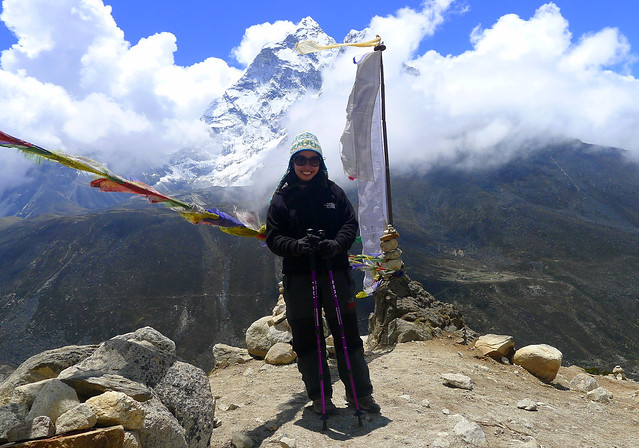
Ama Dablam
Waiting for Ama Dablam (6,812 meters) to reveal herself
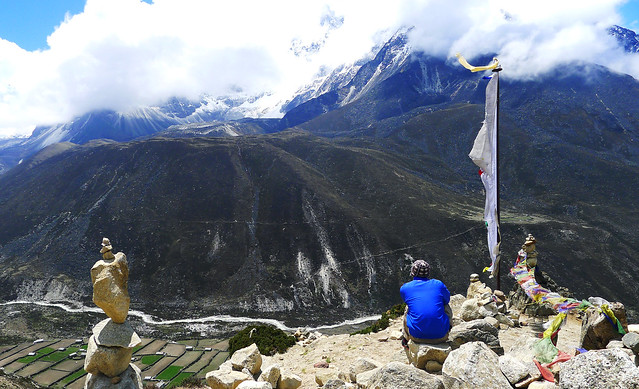
The uphill trek wasn't actually that bad; Madan and I talked a lot in between catching our breaths. Talking really helped pass the time, especially since steady uphills can be such total drudgery. As I headed up, I had glorious views of the hills and the river cutting through the valley. I could see Mt. Thamserku (6,608 meters) in the distance and sneak previews of the greater Mt. Ama Dablam (6,812 meters), barely seen behind thick, passing clouds.

Although it was just a short trek, I could feel the thinning air and stopped to take a break once in a while, which is what every sensible trekker should do.  We were roughly at an elevation of 4,500 meters, I suppose, by the time we reached the top of the hill at 11:00 am.

Prayer flags flapped in the strong wind as I plopped down on a rock to guzzle down the contents of my water bottle. We snacked on chocolate biscuits and took turns watching for Ama Dablam to appear, as she remained hidden behind the clouds.

And then I gasped and pointed behind Madan, and he turned to look. The clouds had finally parted, and there was Ama Dablam herself in her full glory.

The Himalayas: Ama Dablam
The majestic Ama Dablam, one of the Himalayan greats
My face was smarting from the cold and wind, but I was happy to be where I was at that point in time. For a moment, all my worries and fatigue melted away, and I just soaked in the experience of being brought face to face with one of the most striking mountains in the world.

We spent about 30 minutes at the top of the hill, taking photos and enjoying the good weather. It was a halcyon day, a great day--one of the brightest spots in my challenging 12-day trek. And it was exactly the kind of day I needed to inspire me to persevere. I knew I needed all the motivation I could get to make it through the next two days, which were the most crucial.

I was in good spirits when we returned to our teahouse in Dingboche by lunch time. Good weather, good trek, and zero signs of altitude sickness. That evening though, I could really feel the thin air. Tried hard to breath in as much as I could. My nose was stuffed due to a cold that wouldn't go away, and every time I blew my nose, there was some blood mixed with the snot (sorry, too much information).

But other than that, I was feeling good and strong enough, as my body was indeed reacting well to the daily medication of 250 mg of Diamox. Sleep came easy enough that night.

Everest Base Camp: Ama Dablam
The great Ama Dablam and wee, hobbit-y me
* * *

If you want the same Everest Base Camp trek experience I had, visit Himalayan Planet Adventures and go for the 16-day Everest Base Camp trek package.


17 July 2013

Everest Base Camp Trek - Day 4: Pangboche and the Start of Altitude Sickness

To read all posts on my Everest Base Camp trek, click here for the complete series.


Kyanjuma on the Everest Base Camp trail
The wonderful view from my room at the Kyanjuma teahouse

Day 4: June 1, 2013

Woke up early the next day, sleepily making my way in the semi-darkness to the toilet.  There was no opportunity to take a bath, so I had to make do with wet wipes. For someone who loves taking a shower twice a day, being forced to go without a bath for several times on this trek was a reality I had to struggle with. I think I shed a tear or two that morning as I cleaned myself from head to toe with baby wipes.

Even brushing my teeth was a challenge, because it hurt to rinse using ice cold water. Oh, the perils of this trek.

We were on the trail by 8:30 am, right after breakfast. Fog, fog everywhere. No views of the mountains to be had that day, and it rained at times.  The path that morning was mostly descent, which was frustrating. The way from Everest Base Camp back to Lukla is the same way that one has just taken; you just do the trail in reverse. There are no shortcuts, no lovely cable cars to bring you back to civilization in a jiffy. Everything is done on foot. So any continuous downhills that I would encounter on the trek didn't feel like progress or a 'treat' for me, because I knew I would have to encounter these as uphills on the way back.

There we were, going down, down, down--all the way to the river bed. And then we had to go all the way back up at some point. We were doing some serious ups and downs on the hills. It was sheer madness. Who designed this blasted trail, I wanted to scream out.

Twenty-one-year-old Dhan Kumar was just pure Sherpa strength, hardly breaking his pace as he went way up ahead with my duffel bag. What a Legolas. I wanted to beg him to carry me on his back all the way up to Base Camp. But all I could do was sigh and trudge up the never-ending path to nowhere. Madan stayed with me, of course, and we kept each other company by telling stories and jokes. At least at this altitude, even with the crazy ups and downs, we could still afford to talk and laugh. On Days 7 and 8, the mere act of talking while dealing with the thin air and the rocky terrain became too exhausting to do.

Lunch stop was Tengboche, which was at an elevation of 3,867 meters (12,684 feet). It was cold and foggy; the temperature was about 5 degrees Celsius. Five degrees in a city like New York would be okay for me; five degrees up in the mountains felt like a different story altogether. Stood inside the teahouse's dining hall, shivering in spite of my three layers of clothing, a wool hat and fleece gloves. Even hot chocolate wasn't enough to keep me warm, and it was too early in the day to fuel the yak stove.

When we left Tengboche after lunch, we were laughing nervously because it was getting foggier by the minute, and it had started to rain again. As usual, the mud was a huge deterrent to our progress, and what should have been a 2-hour trek from Tengboche to Pangboche became a 4-hour one.

A dull, throbbing pain in my head was making its presence more and more felt as the minutes, hours ticked by. I suddenly felt so fatigued; it was the strangest feeling. I knew then that I was already in the minor stages of altitude sickness. Madan was watching me closely the whole time, probably looking out for other symptoms. He even drew a line in the mud and asked me if I could walk straight on it. God, I felt I was taking a sobriety test for drunk driving.

Fortunately, I managed to walk straight (and even crack a joke in the process), which was a relief to my guide.  When the two of us were around an hour's walk away from Pangboche, I was so happy to see Dhan Kumar come back for us on the trail.  He insisted on relieving me of my day pack and carrying it the rest of the way to Pangboche. (Yes, he is so fast on the trail, he can zip back and forth like The Flash. Who are these Sherpas and why are they so superhuman.)

At last we reached Pangboche (elevation: 3,930 meters / 12,890 feet), as dusk was setting in. I practically cried for joy when I saw there was electricity at the teahouse. (This homey teahouse would end up to be one of my favorites in the entire trek.) Sat down in one corner of the dining hall, trying to withstand the headache that was slowly draining my ability to think and speak. It even hurt to turn my head from side to side.

Dinner was vegetable momos (dumplings) and a small bowl of garlic soup. I could only down half of the soup and two pieces of momos. My appetite was shot--yet another sign that the altitude was affecting me. By this time, Madan had ordered me to take Diamox for the altitude sickness, and I was happy to oblige. He was talking to me quietly, but his words were stern. He was saying things like, "How are you now? How bad is the headache? Do not lie to me. If you're still feeling bad tomorrow morning, we will descend.  I will update Naba on your condition." He even gave his and Dhan Kumar's room number so that I could wake them up in case I was feeling really sick in the middle of the night.

I didn't even have the energy to laugh when he asked me to rate my headache: was it a 'small', 'medium' or a big headache? I wanted to say pain is relative, but I could only nod in agreement to his instructions and mumble, "Medium headache." Rain, mud, steep switchbacks, and yes, even jokepes had now paled in comparison to the all-too-real threat of high altitude--the effects of which are greater and more dangerous than most people realize.

It was a quiet evening as I sat there, listlessly looking at the books on my Kindle, too tired to even read. I wasn't ready to sleep yet, because I wanted to get a feel of how my body would react to Diamox while I was awake. There were two other female trekkers in the dining hall, reading on their own Kindles.

Suddenly, there was a ruckus in the kitchen where the family members who owned the teahouse were gathered. A fight had broken out between two brothers, and we could hear punching, shouting and some banging of kitchen pots. The boys' parents and a few other people started intervening, and we heard more shouting going on. The three of us trekkers could only sit, gawk and try to decipher what they were all saying to one another. The youngest girl in the family strode out of the kitchen, looking upset.

Some fifteen minutes later, the two brothers who had fought actually sat near us by the yak stove and conversed with me and Madan like nothing had happened.

There is never a dull day on this trek. Never.

I had realized that day that even the hassle of dealing with altitude sickness did not stop me from falling in love with Nepal and all it had to offer: the unpredictability of the trail, the genuine warmth of the people around me, and the beauty and sheer power of Mother Nature that I was to behold each day on the trek.

Bedtime was 10:00 pm and I slept like the dead--only to wake up at 3:00 am with an incredible urge to pee. Diamox is a diuretic, and I was shivering in the cold as I hurriedly bundled up and rushed to the common toilet to pee like crazy. Blessedly enough, the headache was gone by that time, and I was able to sleep right away when I went back to bed.

* * *

If you want the same Everest Base Camp trek experience I had, visit Himalayan Planet Adventures and go for the 16-day Everest Base Camp trek package.


16 July 2013

Everest Base Camp Trek - Day 3: Trek to Kyanjuma

To read all posts on my Everest Base Camp trek, click here for the complete series.

Everest Base Camp Trek in the Himalayas
The views on the trail. Photo by Gina Sales, 2013

Day 3: May 31, 2013

My guide Madan once told me that he has had some clients in the past who, after Day 2, had decided to turn back and not push through with the rest of the trek.

Well, I didn't want to be like those people. I had my heart set on reaching Everest Base Camp even if I had to brave a thousand crazy jokepes following me everywhere.

Philippine flag in Namche Bazaar teahouse along Everest Base Camp trail
Yay, go, Bryan, my fellow Filipino trekker! Wish I brought my own flag! 
Although I wasn't in the mood to trudge in the rain once more after that nightmarish second day, I was glad that my headache and slight fever were gone when I woke up the next morning. In the dining hall of the teahouse in Namche Bazaar, I was pleased as punch to encounter a Philippine flag on the wall as I was having breakfast.  It was to be the first and last Philippine flag I saw all throughout my trek--and I completely regretted not bringing one. I didn't know that EBC trekkers all over the world would be so hard core about bringing flags and decorating the walls of teahouses. I promised myself that the next time I visit the Himalayas, I would carry one, and place it in one of the teahouses as proof that I've made it to Everest Base Camp and back.

But on that third day, I was just so happy to see my country's own flag. The Nepalis I encountered on the trail would always remark that there aren't a lot of Filipino trekkers in the Himalayan region. Even Madan and Dhan Kumar said that I am their first Filipino trekking client. Ergo, I had become a novelty to these Nepali people I've met--and I would always get a load of questions from them about myself and my country.

Before leaving Namche Bazaar, we stopped by a store so I could stock up on key items such as hand sanitizer, bottled water, toilet paper, ziplocs, multivitamins, playing cards, and chocolate bars. (Yes, chocolate bars are a great source of energy on the trek.  Snickers, Mars, and Bounty are sold everywhere on the trail and will help pull you through a hard day's trek. Everest is simply the best justification for devouring all that chocolate.)

Madan was raising his eyebrows as I did some panic-buying like it was wartime or something; I suppose he was wondering how I was going to cram all those inside my already-full day pack. (I ended up stuffing some items into his backpack, haha.) But really, the best place to stock up is in Namche, since goods become scarcer and pricier as one goes up.

leaving Namche Bazaar
The stone staircases leading out of Namche Bazaar are rough and steep. My teahouse is located at the bottom!
The road leading out of Namche Bazaar is steep and a bit cruel. I was irked to see this cane-wielding Sherpa woman (who looked about 80 years old) pass me on the way up. Jesus. I felt I was the 80-year-old one. And in just about 10 minutes since we left Namche, I had already completely burnt off all that I had eaten that morning.

Normally, trekkers stay at Namche Bazaar for an extra day to acclimatize.  But we were heading that day to Kyanjuma, which stood at an elevation of 3,500 meters (11,482 feet)--almost the same as Namche. But to get to Kyanjuma, I would have to do a series of ups and downs for a few hours. Thus, I would still be getting the 'benefits' of a proper acclimatization: a day's walk to keep me fit and adjusted, as well as being able to sleep at the same altitude level for another night.

The trek to Kyanjuma took 4 and a half hours that day. It was a gradual, sloping walk with absolutely marvelous views of Thamserku, Kwangde, and the surrounding hills. There was one mountain that particularly impressed me; I pointed to it and asked Madan what its name was.  He looked to where I was pointing and shot me this incredulous look as if to say, you must be kidding. After being rendered speechless for a few seconds, he then said matter-of-factly, "That is not a mountain.  That is just a hill."

Face palm. I kept forgetting that the hills in these parts would already be considered mountains in the Philippines.

Kyanjuma on the way to Everest Base Camp
The village of Kyanjuma. Elevation: 3,500 meters (11,482 feet).
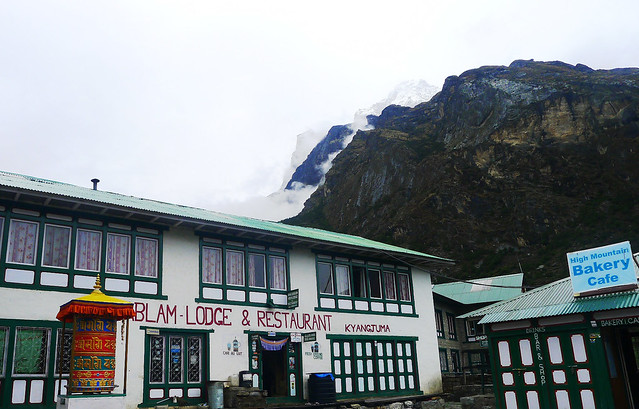
Reached our teahouse in Kyanjuma past 1:00 pm. It was cloudy during the trail, but at least we weren't trekking in the rain. Throughout this EBC experience, I had learnt to be grateful for any good things--small or big--that came my way. We stayed in this homey teahouse called Ama Dablam where the motherly owner prepared some really delicious vegetable momos and pasta with tomato sauce and yak cheese.

The entire afternoon and evening were spent playing cards with the boys. Seriously, there is nothing else to do after a day's trek except read, write notes, eat, play cards, stay warm by the fire, and sleep.  That basically sums up life on the trail.  Madan refreshed my memory on the card game 'Crazy 8' and then he also taught me 'Mr. President' and this super silly game called 'Hello King, Hello Queen, Hello Jack' which had the three of us laughing hysterically all the way into the night. It would end up being our favorite game during the trek.

Still no electricity that day.  My iPhone's battery had died already that afternoon and I was running low on camera batt. We played cards with our headlamps on until we realized that it was time to go to bed--at 8:00 pm.  Even though it was so cold in my room, I slept comfortably that night, snuggled under thick blankets with my camera close to my chest to prolong its battery life through body heat.

* * *

If you want the same Everest Base Camp trek experience I had, visit Himalayan Planet Adventures and go for the 16-day Everest Base Camp trek package.


09 July 2013

Everest Base Camp Trek - Day 2: Phakding to Namche Bazaar

To read all posts on my Everest Base Camp trek, click here for the complete series.


on the trail to Everest Base Camp with my guides
I enjoy taking stolen shots of these two: my porter Dhan Kumar (left) and my guide Madan (right) 

Day 2: May 30, 2013

This was, without a doubt, one of the worst days on the trail.

During the trek briefing back in Kathmandu, Naba of Himalayan Planet Adventures (the trek agency I chose) told me half-jokingly, "If you don't cry by the end of Day 2, that means you're fit enough to do the Everest Base Camp trek."

And so I woke up that second day, knowing that I would be facing a long trek with some particularly challenging uphills. Our destination was Namche Bazaar, the biggest Sherpa settlement in the Himalayan region which stood at an elevation of 3,440 meters (11,283 feet).  That meant a total ascent of 788 meters (2,585 feet) for that day alone. My heart sank when we left the teahouse at Phakding, for I had noticed that the light rain that had started falling early that morning seemed to show no signs of letting up.

In fact, it rained the whole day. Gloomy weather altogether.  What was supposed to be a 7-hour trek that day became 9 hours of misery because of the muddy, slippery trail that we had to deal with. The trekking poles were a blessing, especially in the last three hours of painful uphills past Jorsale village at the end of the day.

I was doing alright that morning in spite of the weather. A combination of uphills and downhills quickly got me worked up into a sweat, and I was already dying to peel off the layers of clothing I had.  I was covered head to toe in waterproof gear (God bless Columbia for making such excellent waterproof hiking boots; my feet stayed completely dry) which shielded me from the rain and the cold--but sadly enough, I was totally sweating inside my softshell jacket and light thermals.

One of the things I enjoyed most in the trail were the suspension bridges.  There were around nine of them, I think, and I considered them a welcome break from the monotony of trudging up and down muddy, dung-filled paths. It was a good thing I wasn't afraid of heights, because the bridges were a bit scary in their own right--narrow, slippery at times, with the great Dudh-Kosi river rushing beneath. I stopped somewhere near the middle of a suspension bridge just to take a quick video using my iPhone.


My first sobering experience during this trek happened on a suspension bridge. I was conversing with Madan after we had easily crossed a bridge.  And then to my surprise, four Sherpas seemed to burst from out of nowhere, carrying a stretcher with someone lying on it. They ran--flew was more like it--across the bridge, because obviously the life of whoever was on that stretcher depended on their speed.

I was flabbergasted. I knew Everest Base Camp wasn't a rainbows-and-unicorns kind of trek and I was even expecting to half-stagger, half-crawl into Base Camp--but I hadn't counted on seeing someone on a stretcher. On my second trekking day, for heaven's sake. I was jolted into the reality of the situation; on rainy, cloudy days such as this, a helicopter rescue is pretty much a no-go. For anyone needing critical medical rescue on the trail under such bad monsoon weather, it was either rapid descent on foot, rapid descent via stretcher, or staying put wherever you were (with the last option likely leading to death, as medical facilities are virtually non-existent on large stretches of the trail).

I remember saying, "Oh my God, oh my God, I don't want to die...!" And the boys were looking at me in semi-amusement, with Madan hastening to say, "No worries, you're with us mountain men. And I have a medical kit!" And Dhan Kumar just grinned at me and said, "Don't worry, chicken curry!"

I nearly died laughing. Who was I to worry when I had such excellent companions on the road to Everest?

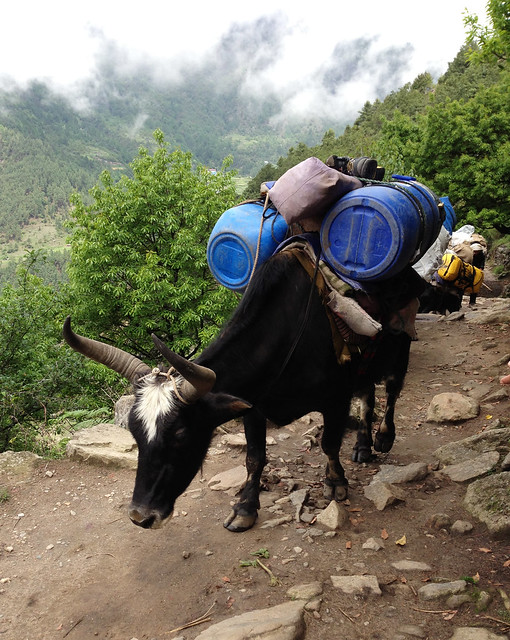
jokepe on Everest Base Camp trail
The jokepe, a hybrid of yak and domestic cattle,
can be found frequently on the trail to Everest
I mentioned earlier that I had to deal with dung on the muddy trails.  The rain had turned some parts of the road into pools of slushy mud that had rocks and dung everywhere. It was hard to tell at some point what I was stepping on.  The reason there's so much dung on the road is because many animals ply this route up to Base Camp and back--horses, yaks and jokepes (a hybrid of yak and domestic cattle)--which all carry food, water, trekking equipment and trading goods up and down the mountains. The yak is the main beast of burden in this country, but is seen higher up on the trails.  So what I encountered a lot in the first few days were the jokepes, who are not as hairy as yaks but have the same scary-looking horns.

Every time a herd of jokepes is encountered on the trail, everyone needs to step aside and practically hug the mountain side. Stay on the edge of the mountain or hill, and chances are, a jokepe can nudge you off the cliff with its horns. Good luck with having to deal with them on a suspension bridge.  Because when you do, you need to turn back and run and wait for all of them to pass, because the bridge is too narrow to fit a person and a herd of jokepes. These animals kinda scared the living daylights out of me, and I always made sure to avoid them in a major way. Death by jokepe doesn't seem like a dignified way to leave this world.

By the second half of the day, the rain had gotten worse. My boots and the lower part of my hiking pants had mud streaks--and in all likelihood, jokepe dung as well--all over. Met a group of trekkers on their way down, and one of them (a female) slipped right in front of me, falling on her butt. I was lucky not to have been hit by her; otherwise, I might have slipped as well, or worse, fallen off the cliff. 

We were somewhere past the 3,000-meter elevation mark, and I was breathing heavily already from the high altitude.  By that time, I was feeling a slight headache and I wondered if that was the start of altitude sickness. I forced myself to take it easy, and do it one step at a time up the steep and slippery paths. The uphills in the last few hours were a challenge, and I knew that this was the difficult part that Naba was talking about. One trekker--an American man in his fifties--on his way down yelled out to me encouragingly, "You can do it!" 

On this trail, all trekkers are the best of friends.  You all just simply had to be, regardless if you knew the person or not.  No one can feel your pain as acutely as your fellow trekkers.

altitude can kill
"Altitude can kill." This was the sign that greeted me before I entered Namche Bazaar territory. Such cheer. (Oh, and free movie, anyone?) 
It was a blessed relief to have finally reached Namche Bazaar at the end of a long day of traipsing in the rain and mud. Near the entrance to Namche, I even had to deal with this annoying jokepe who followed me everywhere I went; when I stopped, it stopped. And when I started huffing up the path, it followed me closely from behind.  It took all of Madan's willpower not to laugh because I kept saying to the jokepe, "Go away, stop following me! Madan, make it go away, please!" 

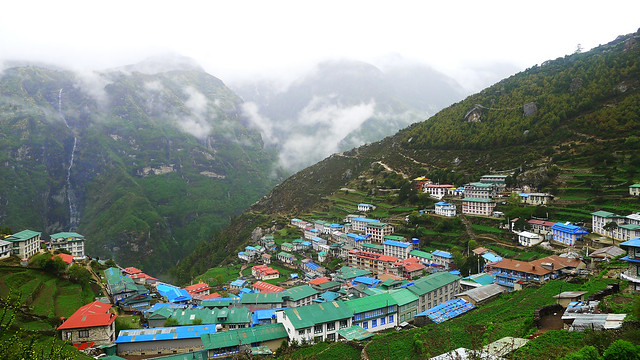
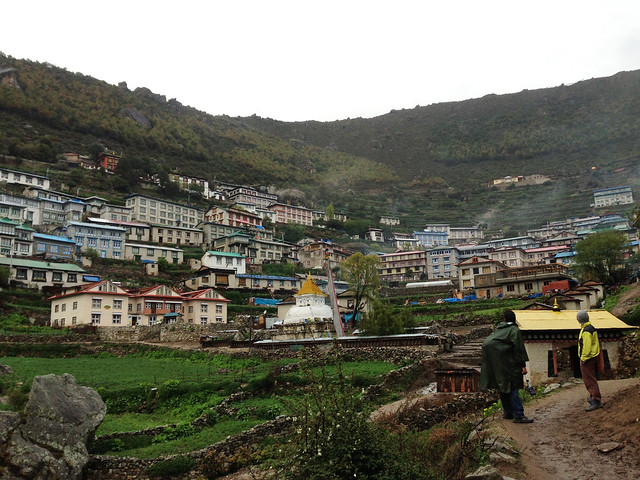
The difficult trail on Day 2 did not make me cry, but that jokepe sure drove me close to tears. I was so petrified of that ridiculous animal, I could barely stop and admire the large Sherpa settlement of Namche Bazaar. The busiest and most populated part of the Himalayan region, Namche Bazaar consists of a sprawling mass of colorful houses, restaurants, and tea lodges all prettily laid out by the side of a hill.  

We stayed at The Nest teahouse in Namche; it was owned by the same person or family managing The Nest teahouse by the Lukla airport. When we got to the place, there was no electricity; that entire part of the region had to go without because the government was doing repairs of some sort that affected the power. My room was spacious and I had my own bathroom, but the hot shower was practically non-existent. Was feeling so extremely dirty from all that mud that I peeled off my clothes without hesitation and braved the cold shower.  Which was a mistake, really, because by the end of my bath, I was shivering in the cold and nursing a headache that was getting a bit worse.

arriving at Namche Bazaar
We reach Namche Bazaar. Elevation: 3,440 meters (11,283 feet)
Madan wanted me to take Diamox (altitude sickness medicine) already at that point, but I pleaded and said I'd wait and see first.  I was feeling slightly feverish after nine hours in the rain, and I took flu/fever medicine and Dolfenal (a painkiller) for the headache.  I didn't want to add Diamox into the mix, as I wasn't sure how my body would react to it combined with all those meds. But I had to follow at least the order from my guide to have garlic soup along with the dal bhat I had for dinner. Apparently, garlic soup naturally helps ward off altitude sickness.

I collapsed into bed in my pitch-black room after dinner. It was 9:00 pm. Fell into a deep, blessed sleep but I woke up at around 2:00 am when I felt something fall by the side of my face, on my hair. Then it fell off my bed and I heard it skitter across the floor in the darkness. Under normal circumstances I would have screamed; it sounded like a mouse or a rat. But I was too exhausted and sick to care, and so I went back to sleep, mumbling to myself that at least it wasn't a frog.

No tears at the end of Day 2.  If I had managed to survive nine hours in the rain plus a headache, a lovesick jokepe, and sharing a room with a rodent in the darkness, then sure, I could handle anything in this trek.

* * *

If you want the same Everest Base Camp trek experience I had, visit Himalayan Planet Adventures and go for the 16-day Everest Base Camp trek package.


03 July 2013

Everest Base Camp Trek - Day 1: Lukla to Phakding

To read all posts on my Everest Base Camp trek, click here for the complete series.


Day 1: May 29, 2013

My guide Madan showed up at my hotel lobby at 5:15 am; I was barely awake.  Our flight to Lukla was at 6:30 am, and so there was obviously no time for breakfast at Shanker. The hotel had prepared a big breakfast box for me to bring so that I could eat on the way to the airport.

I nearly gagged when I saw the contents of the humongous brekkie box: two sandwiches, an apple, a banana, jam, butter, two muffins, two boiled eggs, water, and juice.  Shared some of my food with the driver and with Madan and stuffed the rest into my daypack.  I'm not a big breakfast person (all I can usually manage in the morning is a cup of hot chocolate), and I just planned on eating the leftover stuff while on the trek.

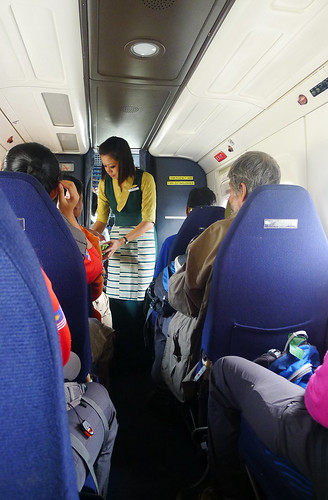
on the plane to Lukla
Kathmandu's domestic airport was crammed with people at that ungodly hour.  A siren sounded, and Madan explained to me that that meant extremely good news: planes were flying out to Lukla today. Hurrah!

As I sat in the pre-departure area, bleary-eyed and craving for hot chocolate, I noticed a big group of Malaysian men and women decked out in full battle gear. They had the words 'Everest Base Camp & Kalapathar Trek 2013' and the Malaysian flag splashed across their long-sleeved tops. They looked strong, they looked fit--hell, they were carrying all their gear on their backs.

I watched as they posed for the camera, doing G.I. Joe-like stances. They seemed so ready to tackle Everest in a heartbeat--and I wondered again, for the nth time, what the hell I was doing on this trek.

Madan and I found out that our 6:30 am flight was pushed back to 7:30 am due to adverse weather conditions in Lukla.  I was beginning to feel nervous; surely, things shouldn't go wrong this early, right? But finally, the boarding call was made over the airport's public announcement system around 7:00 am, and there was an almost mad rush towards the plane. I guess the other passengers to Lukla were as jittery as I was.

I snagged a seat on the left side of the plane which apparently was the one with the better views of the Himalayas. As it was only a 14-seater plane, there was just one flight attendant who quickly distributed mint candy (for motion sickness) and cotton balls (for the ears) to all passengers. The flight lasted for about 35 minutes, offering incredible views of the Khumbu region.

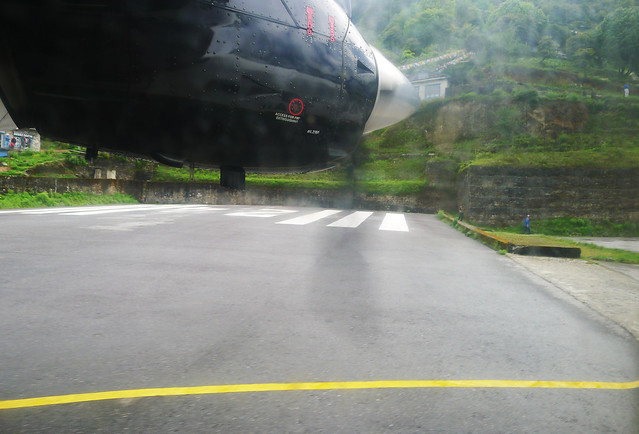
I was about to doze off in a bit, when I noticed that we were heading straight towards a mountain. My fellow passengers were craning their necks, holding up their cameras as a tiny airstrip loomed into view. This was the infamous airstrip of Lukla's Tenzing-Hillary Airport, widely considered to be the most dangerous airport in the world. The runway is so horrifically short, you'd feel like laughing at the insanity of it all. And because it's on a mountain (with a 10,000-foot drop, should things go terribly wrong), the runway isn't completely level. One can feel the incline as the plane lands and taxies. These Nepalese pilots must have guts of steel.

It was also a good thing that we were on a Dornier 228 turboprop, which makes for excellent Short Take-Off and Landing, or STOL (which, in all my years of handling SEAIR and Dornier prior to working for UNICEF, I knew very well), and I felt that there was no need to panic.

But as we landed on the 460-meter runway, I then saw it: a mountain wall located at the end of this bandaid of an airstrip--and I found myself wondering how fast the plane could come to a full stop.

It's not called the world's most dangerous airport for nothing.

The temperature in Lukla was around 16 to 18 degrees Celsius, a welcome respite from muggy Kathmandu. At 2,800 meters (9,184 feet), Lukla has almost the same elevation as that of Mount Apo, the Philippines' tallest mountain. (Whenever Sherpas asked me about the mountains in my country, and I would give them this factoid, they would wheeze with laughter. One doesn't need brains to figure out that Mount Apo's 2,900-meter height ain't much by Nepalese standards.)

landing at Lukla's Tenzing-Hillary Airport
The plane, after a short landing, needs to do a swift right turn to avoid crashing into the mountain

at Lukla's Tenzing-Hillary Airport
Hello from Lukla! I'm so glad to be alive!
Madan brought me to The Nest, a teahouse located right smack beside the airport, for a bit of rest before we proceeded with the trek proper.  It was at The Nest where I met Dhan Kumar, my Sherpa porter. The three of us were finally together, and I would be spending the next 11 and a half days on the trail with them. Guides and porters do make or break a traveler's experience, and so I was anxious to have us all get along. I mean, if this were the Fellowship of the Ring heading off into the wild, it would have to be like a tight Aragorn-Legolas-Gimli kind of trio (and with me being the shortest, I suppose I'd be Gimli in this case, lol).

I was in high spirits at The Nest, because I had just realized at that moment that it was the 29th of May. On this day, exactly 60 years ago, Edmund Hillary and his Sherpa guide Tenzing Norgay reached the summit of Mount Everest, the very first ones in history to do so.  I felt that with May 29 being such an auspicious date, nothing could go wrong for me that day.

For about thirty minutes, I got to have hot milk coffee and was able to go on the Internet to tell everyone back home that I've made it to Lukla safely. Wi-fi connection at The Nest was excellent (much better than at Shanker Hotel) and little did I know that it would be a full 11 days until I would be able to go online once more.

Our destination at the end of the day was Phakding, a 3 to 4-hour trek away from Lukla, according to the itinerary that Himalayan Planet Adventures gave me.  With an elevation of 2,652 meters (8,700 feet), Phakding is indeed lower than Lukla.  You may ask: why am I descending instead of ascending?  One of the golden rules of high altitude trekking is to 'climb high, sleep low.'  So in order for the body to properly acclimatize at a certain altitude level, one needs to descend right after reaching a specific height and spend the night at a lower altitude.

This would be the pattern running all throughout the trek: we would ascend about 300 to 570 meters (1,000 to 1,900 feet) every day and do a descent of 100 or more meters afterwards to rest for the night. The classic Everest Base Camp trail itinerary is designed to give a specific level of safety to trekkers to allow their bodies to adjust accordingly to high altitude. But it is also up to the trekker to be responsible enough to avoid contracting severe high altitude sickness by going through precautionary measures--such as staying away from tobacco and alcohol for the duration of the trek; by not overexerting one's self and not climbing up at a rapid pace; by staying hydrated and drinking 3-5 liters of water a day, etc.

I had been thoroughly briefed by both Naba and Madan on acute mountain sickness (AMS), and I had read up on AMS as well, so I was already being my usual cautious self when we started the trail.  I was slow at first, trying to adjust to the feel of the mountain path underneath my new hiking boots.

(Side note: Yes, I know I should have broken them in--my boots, I mean--but I had no time and I basically used them straight out of the box. And just so you all know, I did not suffer any major foot pain.  After 12 days of trekking on the Everest trail using these brand new boots, I got away with only one little blister on my right toe. Excellent job, Columbia Big Cedar mid hiking boots! Ankle support and traction were top notch.)

Day 1 on the trail
Day 1 on the trail. Still fresh-faced--yahooo!
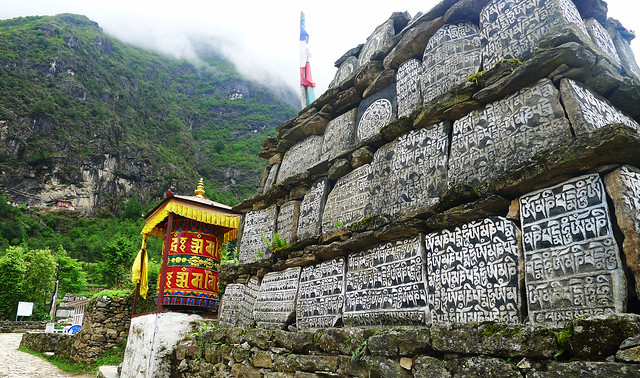
Anyway.  There I was, figuring out my pace and getting accustomized to the trail.  The path consisted of ups and downs, mostly on rough switchbacks, or stone staircases cut into the mountains. Many times, I would come across little Sherpa villages, prayer wheels and these massive mani stones with carved or painted Buddhist inscriptions. The trail was scenic and made me temporarily forget the demanding goal of reaching Everest.

Because our flight was an hour late, we also reached our lunch stop a little later than usual. After a filling lunch of dal bhat (with delicious potato curry) and milk coffee, I felt re-energized and kept pace with Madan.

Buddhist Mani stones and prayer wheels
Beautiful Buddhist Mani stones and prayer wheels found on the trail
In the case of Dhan Kumar, he would usually go ahead, carrying my 10-kilo duffel bag on his back. Throughout the trek, Dhan Kumar would sometimes walk with us or, as porters in high altitude terrain normally do, would trek at a far faster pace and just meet us at the agreed lunch stop and the overnight destination at the end of the day.  After all, he's a Sherpa and has been accustomed all his life to this kind of altitude, so this whole trek is practically a walk in the park for him. A large park, that is.

Madan, as my guide, naturally had to be with me at all times and suffer through my 'foreigner-in-Nepal' trekking pace, haha. I'm sure I must have been awfully slow for him--he who is so sure-footed up in the mountains and has been guiding trek clients in the Himalayas for 5 or so years now.

We reached Phakding eventually, and checked into this teahouse called Hotel Beer Garden. Woohoo! What a name.  Obviously, I couldn't enjoy Beer Garden's alcoholic beverages; if I did, I would probably never have made it to Base Camp.
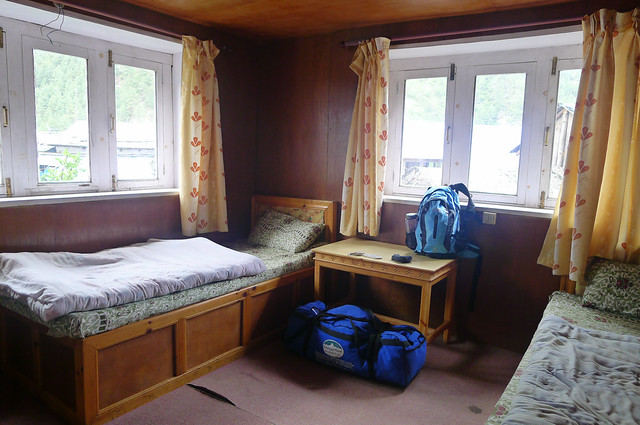
my room at Phakding
my room at Hotel Beer Garden, Phakding
My room at that teahouse had good space and yay, a private toilet with a shower. I was surprised to have one, since I was expecting common toilets all the way.  As you can see from the photo above, the room doesn't seem like much--but when I think of all the teahouses I've stayed in throughout the trek, this room was one of the biggest I've had.  The higher one goes up, the more basic the accommodations on the trail. Rooms get smaller and colder, toilets are located at the far end of the teahouse or sometimes outside, and there is no electricity in many instances.

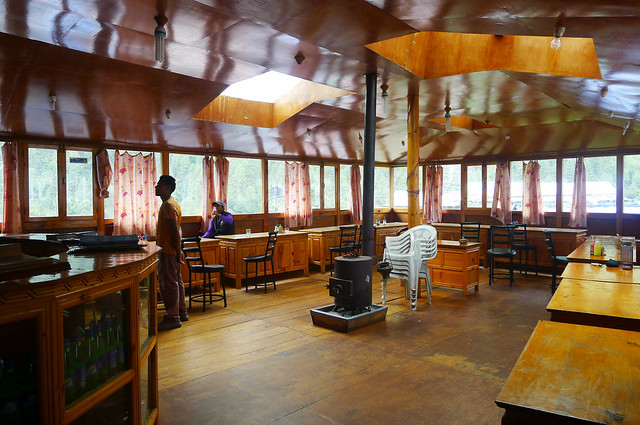
So yes, basically what you're seeing is something that was bordering on luxury level on this trek. As for the main dining hall (where everyone gathers in the evening), it was warm, inviting and wonderfully peaceful during the off season.

the main dining hall
the main dining hall of Hotel Beer Garden, Phakding
First day came and went nicely enough--and I managed to do okay.  Day Two's circumstances, however, would be dramatically different.

* * *
If you want the same Everest Base Camp trek experience I had, visit Himalayan Planet Adventures and go for the 16-day Everest Base Camp trek package.  


30 June 2013

Everest Base Camp Trek - Day 0: Kathmandu

I had spent months worrying so much about my Everest Base Camp (EBC) trek, that I was just quite anxious to get it over and done with and just live to tell the tale.  Not exactly the best way to enjoy 6 months' worth of savings, I told myself ruefully as I sat and watched our plane land and taxi towards the red orange brick structure of Kathmandu's Tribhuvan International Airport (TIA).

TIA is an exercise in patience--well, at least for the arrivals bit. The line at the visa and immigration area took forever, and it wasn't even peak season. One of the nicest things about Nepal though is that the government grants visas to everyone on arrival; because I was going on the EBC trek, I took the 30-day visa which costs only US $40.

I was greeted at the arrivals area by Madan, who, I was to find out later on, was going to be my guide for the entire 12-day trek. He greeted me by placing a garland of flowers around my neck, which was quite a surprise for me, as that kind of welcome is normally done to VIPs when they arrive in the Philippines. I had no idea that was how Nepalis welcomed their guests. I looked around, and sure enough, other tourists who had just arrived were wearing the same kind of flowers on their necks.

Kathmandu is a riot of colors, a total assault on the senses.  Dust and prayer flags everywhere, with motorcycles whizzing by and cars zipping past at an equally dangerous pace. The city reminded me of Cairo--frenetic road activity, local music blaring out from various sources, people in colorful garb, and earth-toned structures lining the streets.

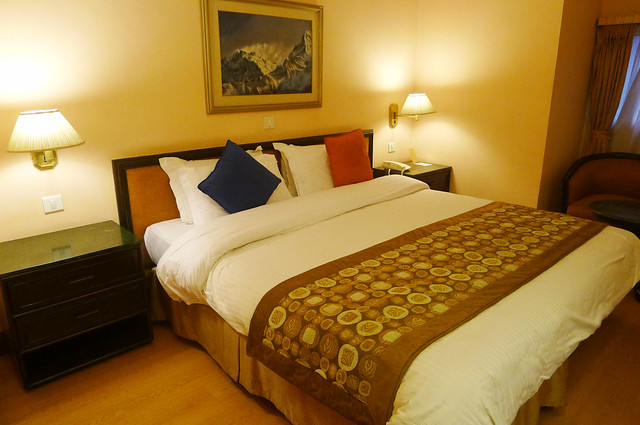
I checked in at Hotel Shanker, this old palace that was converted into a 4-star hotel.  The place, in its own charming way, had a layout that seemed to have no rhyme or reason.  The way to my room was a bit roundabout; I had this sensation of wandering through palace corridors indeed. And my room had all the delightful amenities I was expecting.
my room at Shanker Hotel
I literally just dropped off my bags and immediately headed for the Himalayan Planet Adventures (HPA) office with Madan.  I was to meet, finally, Naba, my 'penpal' for the past 4 or so months, who was going to give me a final briefing on the trek before I headed off into the wilderness.

HPA's office is located in the backpacker district of Thamel, where all the action is.  Normally, briefings don't take so long, but I felt comfortable just sitting there chatting with Naba for an hour or two.

The three most awesome and important things I learned from Naba were:

1. No leeches on the EBC trail (with Madan affirming this piece of good news). And no frogs too. YES!

2. The weather had recently improved after several days of zero flights from Kathmandu to Lukla, and it seemed that the skies would be clear for tomorrow's flight. Could it be that I was a lucky girl, after all?

3. In the likely event that I would need to be flown out of Lukla via helicopter after my trek due to plane flight cancellations, I didn't need to shell out $500 in cold cash. HPA could handle the advance and the fee could be charged to my credit card later on. Seriously, it pays to have a trekking agency watching out for your welfare.


Of course, any helicopter medical rescue (in case I would contract moderate to severe altitude sickness) would be shouldered by my travel insurance company, World Nomads. Plane flight cancellations are a different matter altogether, and I was relieved to know that Naba and his team were going to take care of such things on my behalf.  Basically, all I had to do was haul my ass over to Lukla and climb up to Everest Base Camp.

After the briefing, Madan took me around Thamel because I said to him and Naba that I needed to shop for some gear last-minute and to withdraw some money from the ATM. I was told that there would be virtually no ATMs along the Everest trail, so I needed to have cash with me for any unexpected miscellaneous expenses that I may incur.

Thamel has a superabundance of trekking gear shops, crammed together side and side and bursting with all the trekking apparel, gear and accessories you can think of.  After all, this country is home to the Himalayas--so whatever mountain gear you need, you're sure to find it in Thamel, Kathmandu. I drove a hard bargain with the owner of the store where I bought trekking poles, a head lamp, extra fleece jacket, extra hiking socks, fleece gloves, and all that.  Not sure if it was all really a bargain, but I was just tired from the flight and the shopping.

Part of the 16-day itinerary of my trek (12 days for the trek proper and 4 days in Kathmandu) was a welcome dinner that first night.  I was actually exhausted and dying to pack my stuff, but I also didn't want to miss my first experience of Nepali cuisine.

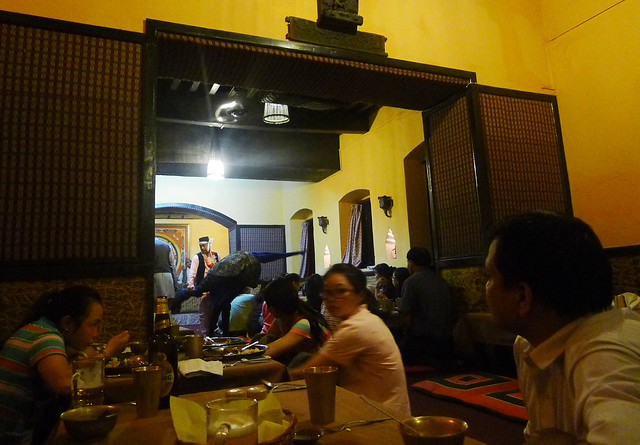
Had dinner with Madan at Nepali Chulo, which is 10 minutes away from Shanker on foot.  The restaurant has that authentic Nepali vibe to it, with low tables, mats and pillows, and people sitting cross-legged on the floor while having their meals. Our dining area was on the second floor, and Madan gestured for me to go up the narrow flight of stairs leading to our table.  "Climb your best," he said with an impish grin. I was to remember his words all throughout my trek.

Naturally, we ordered the special Nepali dinner set which consists of 11 dishes, and as we waited for our food, I had the unexpected pleasure of meeting a fellow Filipino that evening.  Nepali Chulo's low dining tables were set up so close to one another in such a way that a person can practically tap his/her fellow diner on the shoulder.  My new Filipino friend Marlo was seated right next to me, and it was such a nice experience to converse with him, his Nepalese work colleagues, and with Madan that night.

Nepali Chulo's fixed dinner set consisted of popcorn (the strangest appetizer I've ever come across, as this is normally a snack you'd have at the cinema), steamed momos (Nepalese dumplings), curry, wild boar meat (!), some delicious cold yogurt for dessert, and the traditional dal bhat as the main fare. Dal bhat, the ultimate comfort food of the Nepalis, is basically rice (bhat) and cooked lentil soup (dal) supplemented by vegetables and sometimes with roti or papadum.
authentic Nepalese cuisine in Nepali Chulo, Kathmandu, Nepal
authentic Nepalese cuisine at Nepali Chulo
Because Nepali Chulo is usually the place you bring foreigners to for a taste of Nepalese cuisine, there were cultural dance presentations held throughout the night.  I was tired, but I enjoyed the food, ambiance and conversation that took place.

As I crawled into bed that night after an hour of packing and re-packing stuff I needed for the trek, I fell asleep in the middle of praying.  I don't think the Lord could blame me; the lure of a comfortable bed was too much, and I needed a lot of rest before tackling the first leg of the trek the next day.

* * *
If you want the same Everest Base Camp trek experience I had, visit Himalayan Planet Adventures and go for the 16-day Everest Base Camp trek package.  


29 June 2013

Everest Base Camp Trek - How It All Started

Everest Base Camp Trek Himalayas
The Himalayas - photo by Gina Sales, 2013
Yes, I've made it to Everest Base Camp this year.  And yes, I'm pretty much unscathed, unscarred from the experience--and raring to do it a second time in 2014.

Just to make it clear from the very start, I'm no trekker. At least not the kind that joins local mountaineering groups and heads for the mountains every weekend.  I've done a few treks here in the Philippines, since I enjoy the outdoors (as long as I don't encounter any frogs, I'm fine) and I like to keep fit.  But that basically classifies me as a casual, one-off trekker, and not some person who ogles the stuff at R.O.X. and owns camping gear and whatnot.

So why the sudden and insane leap to do Everest Base Camp?  Even I have managed to surprise myself.

After my trip to Egypt last October 2012, I was scouring the Internet in January 2013 for ideas on my next--okay, I'll say it, even though it sounds so hokey--big adventure.  My window of opportunity this 2013 was only between end May to July (and to hold it in July was pushing it, due to my work commitments).  I thought about going back to Europe and I was, like, meh, never mind.  Western cities can wait even until I'm old with wobbly knees and a bad back. Machu Picchu (one of my biggest dream destinations) was at the top of my bucket list, but the whole trip and its corresponding expenses--plane ticket, the trek, accommodations, etc--was something I couldn't afford right now. The air fare alone was too rich for my blood.

Those on my 2013 travel destination short list were:
1. Machu Picchu, Peru
2. Petra, Jordan
3. the Ancient Silk Road within China
4. the TransMongolian Railway route from Russia to Mongolia to China
5. Myanmar

Italy-Austria-Czech Republic nabbed the desperate, I-don't-know-what-else-to-think-of 6th place.  I was getting frustrated during my online travel researches; I wasn't keen on doing Jordan yet because I just got back from Egypt. I wanted to do the Silk Road and the TransMongolian Railway journey in my late thirties, and Myanmar was said to be better in December.  And Europe was, well, oh I don't know, uninteresting at this point in time.

I had my heart set on doing the 4-day trek to Machu Picchu, and I was feeling depressed about the astronomical costs, but then suddenly, in a totally wild Eureka-like moment--Everest Base Camp popped into my head.  A few seconds of disbelief at the utter absurdity of my idea; a snort (I snorted at my own craziness) followed by a fit of nervous giggles; a heart-pounding, looming realization that, hello, Everest is in Nepal, and Nepal is in Asia, and that meant a more affordable trek--and then two minutes later, there I was, typing madly to see what good old Google could come up with in terms of 'Everest Base Camp trek' searches.

The Internet is teeming with information on local trekking organizations in Kathmandu who offer Everest Base Camp (EBC) trek packages.  I wasn't planning to wing it by flying to Kathmandu and just picking a guide and porter there on the spot, hell no.  I'd normally crave my share of adventure, but I like being organized about it.  Some people like to live a little more on the dangerous, unpredictable side and just plan travel arrangements as they go--but you see, travel costs money, and I subscribe to that school of thought that proclaims it is more cost-effective if I plan my travels well before flying out to my chosen destination.

I sent out several email inquiries to Nepalese trekking agencies on my not-so-short list regarding their trek package costs. When I went online the next day, I was, like, whoa, why is my inbox  flooded already and why are all these Nepalis asking to be friends with me on Facebook? Was I (my name, my identity) that searchable so much online? To their credit, these Nepalis were amazing in terms of speed of response to my inquiry, and I liked how they were so, um, proactive in searching for me on Facebook, haha.

But there was one particular trekking agency that stood out from the 20 or so that emailed back. It wasn't the cheapest nor the most expensive. The package was just right. What made me choose this agency was the quality of response and the thoughtfully prepared 9-page trek brief (saved and sent to me as 'Everest Base Camp - 16 days - for Gina') that was attached to the email.  Yes, I'm a sucker for good client service and packaging.

More importantly, it made sense for me to choose that agency because the trek dates were fortuitously scheduled in such a way that the date I was to reach Everest Base Camp was June 5, my birthday.

That was honestly the clincher.  I wanted to do something big (a.k.a. the Machu Picchu trek) on my 33rd birthday this year, and Everest came in as the sweet and much-anticipated answer to all this narcissistic searching for a birthday adventure.

Suddenly, Machu Picchu looked so corny compared to the mighty Everest.

So, from January to April 2013, I was corresponding frequently with Naba--owner and managing director of Himalayan Planet Adventures--who must have thought I was the most obsessive-compulsive traveler alive.  I had all these neurotic questions about the trail, what to expect, how to deal with altitude sickness, what the weather would be like (I was going to do the trek during the monsoon season, after all). And Naba answered them all, patiently and thoroughly.  He must have had years of experience already of dealing with weird questions from travelers like me.

At some point during all this interrogation and online research about other people's EBC experiences, I was horrified to find out that trekkers could get stuck in Lukla (the starting and finishing point of the EBC trek and a 35-minute plane ride away from Kathmandu) for days due to adverse weather conditions. DAYS. I felt I wasn't ready to commit myself to a world of what-ifs, it-depends and we'll-sees--all brought about by fickle mountain weather. When I travel, I'm always Little Miss Fixed Itinerary. And the weather had always cooperated with me. So far.

I must have realized that at some point though, I was embarrassing myself enough with all these never-ending questions to Naba, and I just had to gulp down my fears and finally say yes, I'll do the trek and I'll just pray to the highest heavens that I won't have to be flown out of Lukla via helicopter after a 5-day delay and that I won't die of altitude sickness, and sure, I'll be sending you my 20% deposit tomorrow, thank you very much.

As the date of my scheduled flight to Kathmandu drew near, I was getting more anxious. I told myself that this was NOT going to be a good trip. After all, who the heck worries this much over travel? I was losing sleep already over leeches, possible ankle sprains, the perpetual online debate over whether Diamox (altitude sickness medicine) should be taken right before or during the trek, and the crushing agony of being forced to go without a bath on the trail for 12 days. The Lukla Fear Factor (a.k.a. being stuck in that place for days and being forced to shell out US $500 for a helicopter ride) was enough to make me consider calling the whole darned trip off.

Some nasty inner voice was telling me I had it all wrong and that I had no business climbing up to 5,364 meters when the highest I've climbed in my life was 2,900 meters and all I've done was 2-3 months of conditioning through boxing and running before the Everest trek.  Hell, I've read stuff on the Lonely Planet forums that many first-timers to EBC do conditioning a year before their treks.

And the worst part was that I didn't even know anybody in my circle of family and friends who had done the Everest Base Camp trek before. Some of my friends were saying I was insane to push through with it even though I'm physically fit; the ones who know me more (sometimes they know me even better than I know myself) assured me that I was going to make it to Everest Base Camp because I had the capacity and endurance to do so. But I was still beside myself with terror and I kept telling those close to me that in all likelihood, I wouldn't be able to reach Base Camp, that I might be forced to go back down after all due to altitude sickness.

All these fears (and my stupid desire in wanting to reach Everest even if it may literally kill me) didn't make for a good start.  And it was way too late to back down now, I realized on the 28th of May, when my plane touched down on Kathmandu.

* * *
If you want the same Everest Base Camp trek experience I had, visit Himalayan Planet Adventures and go for the 16-day Everest Base Camp trek package.  
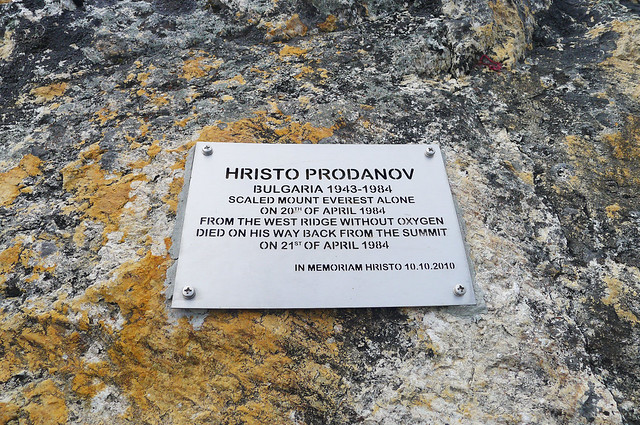
03 May 2013

New York 2011: Museums


Hello, my name is Gina, and I'm a museum addict.


Created with flickr slideshow.

02 May 2013

New York 2011: City Sights


Still in the mad process of organizing all my photos on my Flickr Pro account (although I don't feel so Pro at all -- just the average traveler with a camera, haha).

I hate how incredibly busy I've become, and I hardly have the time to write about my travels anymore. Hopefully, these slideshows will make up for my blog drought somehow.

Anyway, here is New York in the summer, in all its hot, humid glory.


Created with flickr slideshow.

03 February 2013

Made With Paper: Florence's Duomo

Sketch by Gina Sales, 2013
This sketch took me two days to finish on the Paper App on iPad, and I consider that hurried enough already. It's very rough, really, and doing all those strokes on the iPad takes some getting use to. At some point, the touch screen wasn't cooperating, and I was thinking, oh my God, this never happens to me when I'm using a real pen!

I've always had this sinking feeling that I didn't learn enough about light during art class (which was more than a decade ago, and these weren't a lot of classes, I tell you)--and so I really did struggle with the lighting here. Thank God I could play around with the gray and black colors of the pen tool, because if I had to do all those strokes using pure black, I would have failed miserably.

I'm still being stingy here and haven't bought yet the pencil and watercolor tools.  So, yeah, pretty heavy treatment on the eyes. But my younger sisters love it and seem to think that my hands do weird magic while I'm slumped on the coach in an apparent state of ennui. The youngest already wants me to make another sketch (insert sigh).

At any rate, I'm so happy that many friends of mine liked it when I posted it on Facebook.  Thanks for the praises, everyone. Your compliments warm the cockles of my heart.