18 August 2014

Annapurna Base Camp Trek - Day 5: A Hard Day's Trek to Himalaya

To read all posts on my Annapurna Base Camp trek, click here for the complete series.

trekking to Himalaya
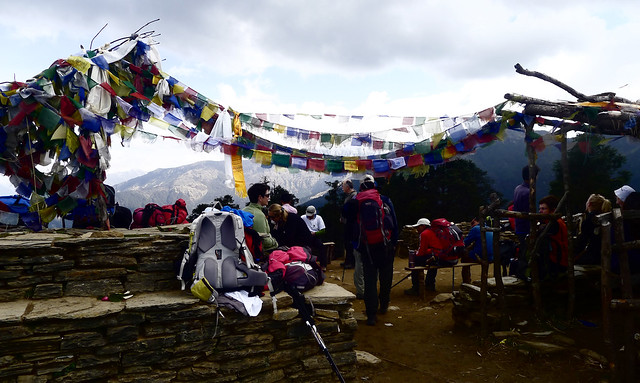
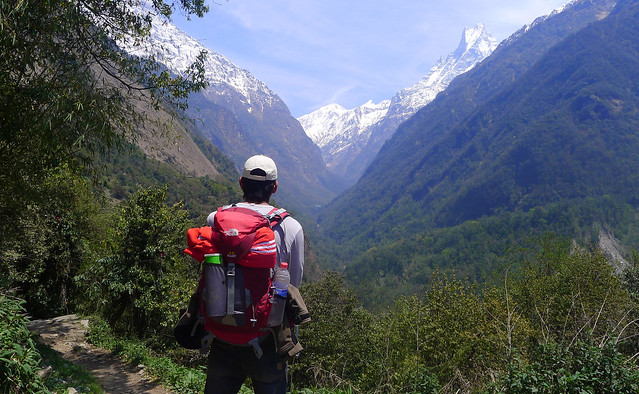
Getting closer to Annapurna Base Camp. Day 5 on the trail. Madan, my guide, takes the lead as always.


Day 5: April 21, 2014

The goal was to trek for 6 hours from Chhommrong to Dovan (2,600 m / 8,528 ft above sea level) on Day Five.  I ended up doing 8 hours of trekking that day. Instead of staying the night at Dovan, I was forced to press on further for 2 more hours and reach Himalaya at an altitude of 2,900 meters.

Let me explain why.

It was a challenging day for me. I think what kinda bogged me down was having no choice but to hike further for a few more hours.  Physical fatigue is one thing, but what really makes or breaks your trek is the level of mental readiness.  

Day 2 was just crummy most of the time, with those Ulleri steps.  But I think I can safely say that on Days 5 & 6, I was quite the bipolar trekker--alternating between silent misery and excessive outward displays of cheerfulness. There were moments when the trail overwhelmed me and I would clam up, not talking to my companions. But I also wanted to dispel any negative attitude as much as I humanly could, and so I tried to compensate by maintaining a stream of chatter that lasted for minutes and minutes. Hari and Madan must have been so confused with me; I would look gloomy one moment and then switch to being ridiculously chipper in a Santa Claus ho-ho-ho kind of way.


trekking to Himalaya
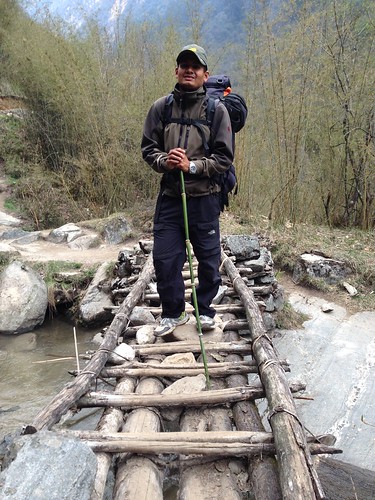
Hari waiting for me to cross this rickety little bridge.
Challenge accepted!
Call it an attempt at mental survival, if you will. When you've been hiking up the mountains for a few days already, one tends to get a bit cuckoo at some point.

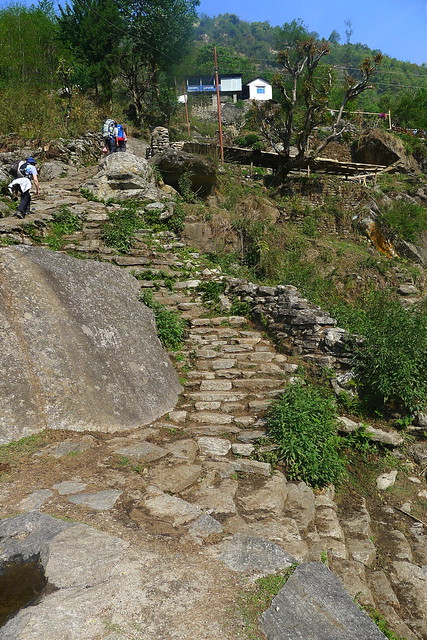
At 8:00 am, I said goodbye to Chhommrong.  The unique part about this place is that it is a crossroads for people heading to Base Camp and back. You have no choice but to pass through Chhommrong.  This isn't exactly good news when you're either leaving or returning to this place.  At the start of Day 5, I had to suffer through 30 straight minutes of cruising from the very high point of the Chhommrong settlement all the way down to a suspension bridge.  The rough steps were too numerous to count.  

My bad knees were screaming in protest, but I drowned out the pain by chatting with Hari all the way down. We left Madan behind. At first, I didn't understand why Madan was taking his own sweet time up at the Chhommrong teahouse; I found out later on he was talking to the teahouse owners and trying to reserve rooms at Dovan for us. (More about that later.)

Anyway, as we swept past a whole gaggle of trekkers leisurely making their way down the steps, Hari said that we would be climbing up the same Chhommrong steps on the way back after reaching Base Camp. Good lord, I thought to myself and tried not to panic. By then, I had just walked past a trekker who was slowly climbing up the steps bare-footed

I stopped in my tracks to ask, "Hi, are you okay??" (Well, what I actually wanted to say was, "Yo, what the hell is wrong with you, sister? Why are you walking without your boots? There's dung everywhere!")

But I restrained myself from any kind of verbal diarrhea.  I had no idea what she was attempting to do.

She looked up and rested her palms for a moment on top of her trekking poles while catching her breath. I think she could read my mind as I stared down at her soon-to-be-sunburned feet. "Yeah, I'm okay. I'd rather walk barefoot for now," she explained in a tired, ragged voice. "The way up is so hard."

Gulp. I wasn't looking forward to a potential Nightmare on the Ulleri Steps, Part 2.


suspension bridge after Chhommrong
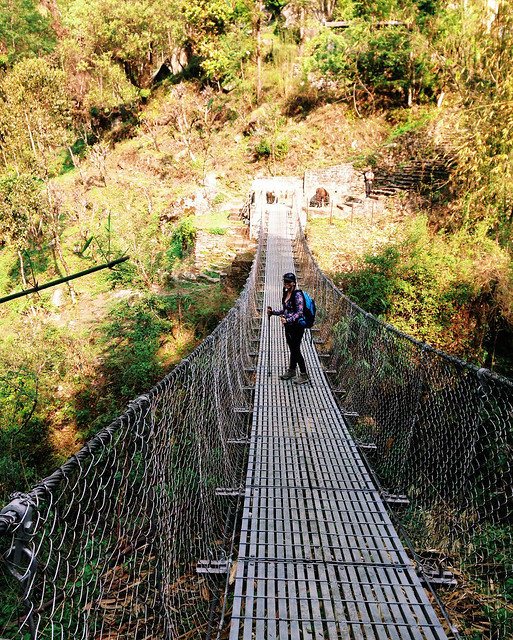
The suspension bridge we crossed upon
leaving Chhommrong.
The descent continued until we found ourselves at the great suspension bridge. Hari explained to me that once we crossed the bridge, we would be doing a lot of ascents that day until we reach our destination. Couldn't really complain about the first few hours of going up; at least my knees could take a break from all those continuous downhills!

Before our lunch at Bamboo (2,300 m), we had a quick toilet break at a teahouse in Sinuwa (2,340 m) with a pretty viewpoint. It was there that I learned that if I, as the trekking client, ordered a glass of cold lemon juice (only for Rs 50), my guide and porter would each be served their own cold lemon juice for free. I couldn't think of a better way to spend Rs 50 (US$ 0.50). And it was a nice little tradition to uphold here in the Himalayas.

During lunch, Madan gave me the lowdown on today's destination. "I checked this morning from Chhommrong, and I found out the teahouses in Dovan are full," he warned. "If I can't get rooms for us in Dovan, we need to go on until we reach Himalaya. If there are no rooms in Himalaya, we go to Deurali."

The last stretch of ascents from Sinuwa to Bamboo had tired me out, but at least my dal bhat lunch had managed to re-energize me. I wasn't worried about the 1-2 hour trek from Bamboo to Dovan; I knew already that Dovan was not an option anymore for an overnight stay because of the lack of rooms. The fact that Dovan, a major stop in the trek, had only 3 teahouses (18 rooms in total) was completely ridiculous though. I wondered how the trail looked like during the busiest season of the year, which is October to November.  Do people end up sleeping on the dining hall tables then?

I then set my sights on Himalaya (2,900 m)  and I needed to ensure that we got there on time to reserve rooms. I didn't relish the idea of being forced to press on to Deurali (3,200 m) which entailed an extra 2-hour trek from Himalaya. So for me, it was Himalaya or nothing. Deurali wasn't an option in my head. I HAD to get to Himalaya on time. Bed space competition was fierce here, since there were only had 2 lodges, or a total of 12 rooms. This was like being in the 19th-century Oklahoma Land Rush or something.

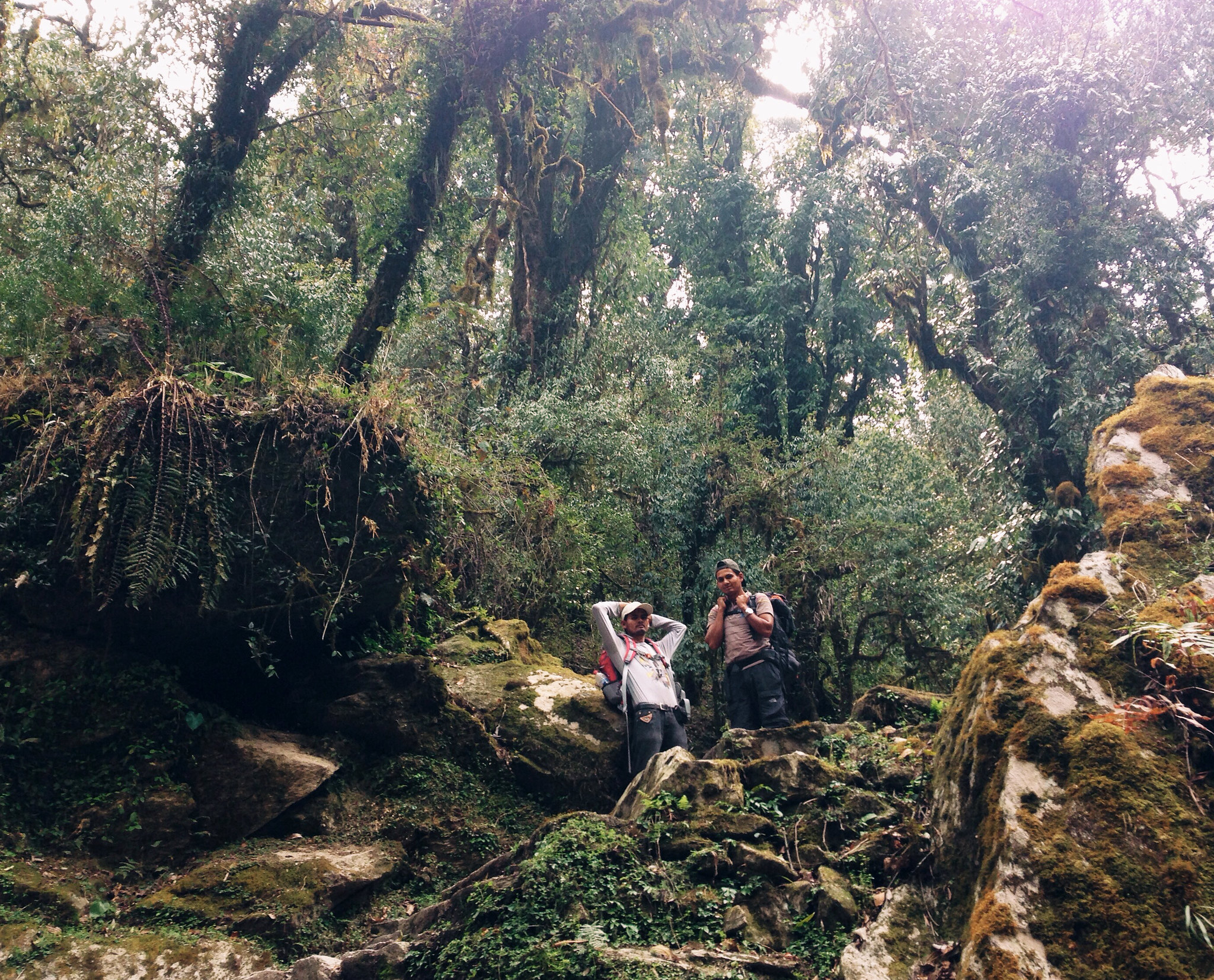
As it was all ascent that afternoon through some dense forest-like areas, my energy was wearing thin by the hour.  When we walked past the Dovan teahouses, I tried not to stare at the other trekkers who were lounging about, sipping tea or reading their books. I didn't want to get all green with envy.

Madan decided that he would go way ahead to Himalaya to get rooms for us three. He would just meet us there, which I thought was a good strategy.  So from 3 to 5pm, Hari and I trudged up the path to Himalaya, stopping once in a while to share and munch on the big bag of trail mix I brought with me.  

I was tired when I reached Himalaya.  The rooms were indeed very limited, and I didn't have the luxury of getting my own room. So for the first time on a trek, I was asked to share a room (with 4 single beds inside it) with two Chinese individuals.  Since I got there first, I was able to choose a nice bed by the window with a ledge for my stuff, some ample floor space for my rucksack, and wall hooks nearby for my trekking clothes.  


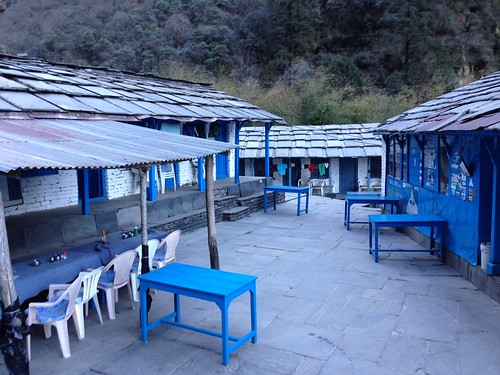
Himalaya teahouse
my teahouse at Himalaya (2,900 meters / 9,514 feet above sea level)

The two Chinese nationals--a boy and a girl--arrived around 30 minutes later. For a moment there, I thought they were a couple, but the girl had told me that they were just traveling as friends. At least I didn't have to undergo the awkward situation of sharing a room with a couple. 

As it got dark and the sun disappeared from view, a few more trekkers trickled in. I was grateful to have reached Himalaya on time; I couldn't imagine heading on to Deurali at night to negotiate for bed space.

It was extremely cold in Himalaya. The gas shower was moderately hot but because it was freezing cold everywhere (even inside the shower), the hot water couldn't do much to keep me warm.  I think there were only two female trekkers--a Thai and myself--who actually braved the shower. Can't speak for the Thai girl, but I can definitely say most Filipino women will find a way to take a bath regardless of climate conditions.

Inside the dining hall, there was no stove, no heat, and everyone huddled together, wearing their down jackets and wool caps. Dinner was an intriguing spaghetti mix of onion, garlic, tuna and cheese, but as always, I barely touched my dish due to lack of appetite. 

Because the dining hall tables were laid out in a way that you end up talking to a lot of people around you, I made friends with the Thai girl, my fellow hygiene addict. She was actually trekking with her twin brother. I had seen them on the trail a couple of times, but it was only now that I was getting to know them. She said that she had initially wanted to do the Annapurna Base Camp trek alone. But her parents wouldn't allow her to go by herself, and so her twin offered to accompany her.  And she revealed, with a giggle, that her brother was enjoying the trek more than she was. 

Lights out at 8:00 pm and I shivered underneath two thick layers of blankets. Today's trek wore me out but in retrospect, I figured that it was a million times better starting Base Camp Day from Himalaya than from Dovan.  It meant less trekking hours on the most important day of the trek.  With that comforting thought in mind, I fell asleep.

trekking to Himalaya
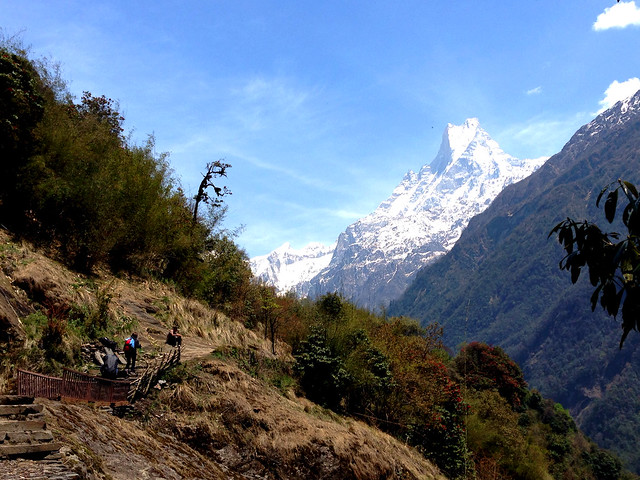
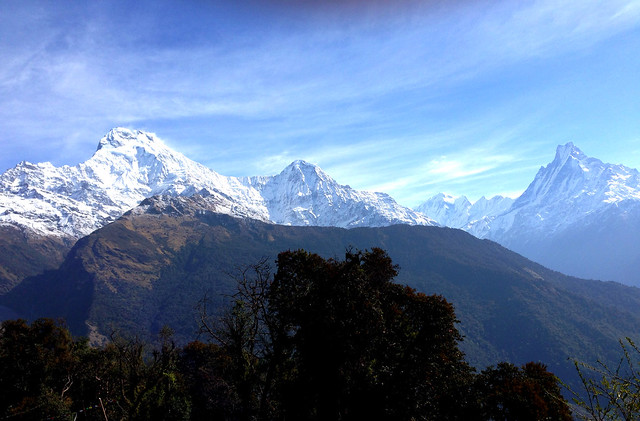
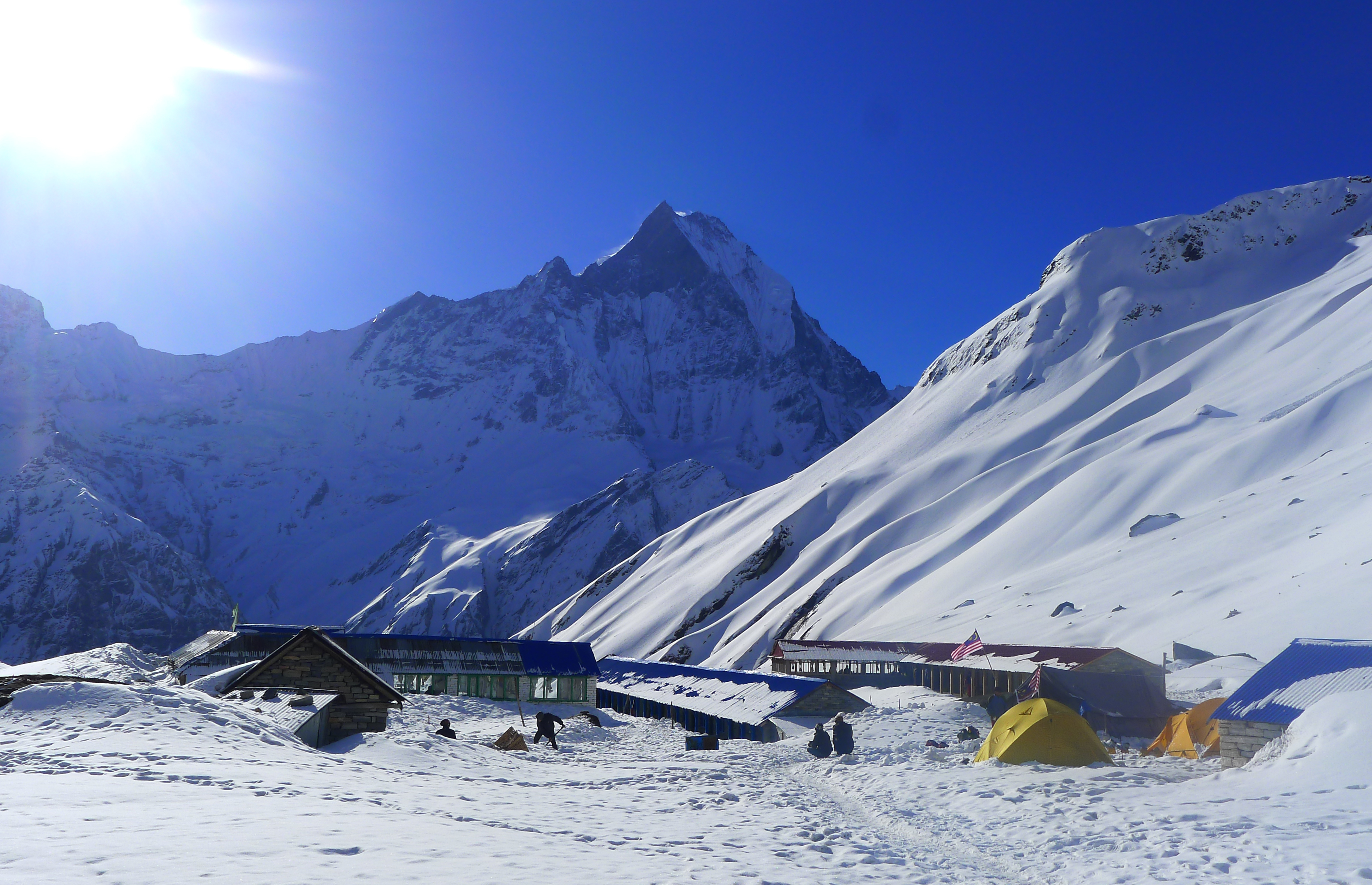
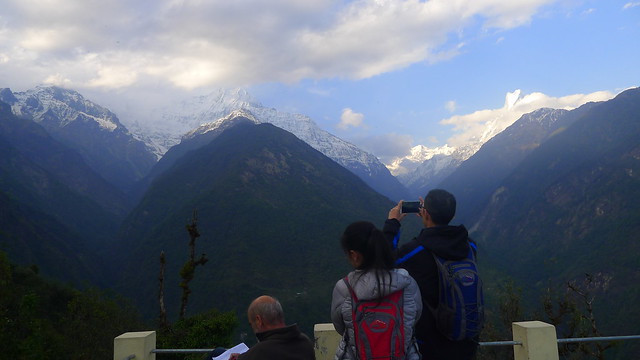
As the day wore on, Machhapuchhre (Fish Tail Mountain) looked bigger and closer. One day left to reach Annapurna Base Camp!

* * *

If you want to do an Annapurna Base Camp trek, do consider visiting the Himalayan Planet Adventures website and check out their 16-day Annapurna Base Camp trek package.
02 August 2014

Annapurna Base Camp Trek - Day 4: The Mad Dash to Chhommrong

To read all posts on my Annapurna Base Camp trek, click here for the complete series.


On the way to Chhommrong
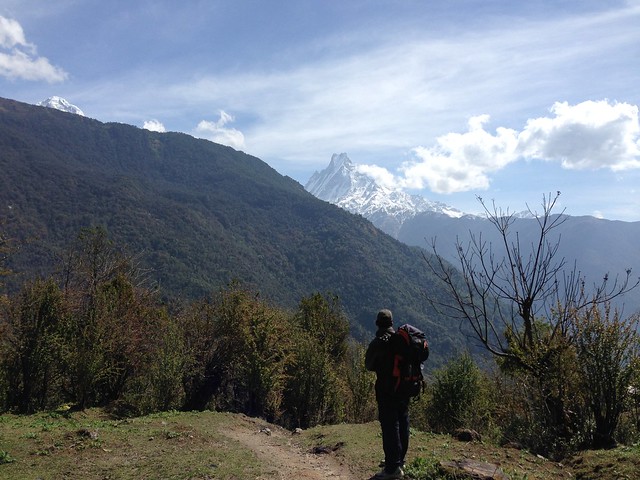
Taken from my iPhone. Hari, with the view of Machhapuchhre on the way to Chhommrong (2,210 m / 7,249 ft
above sea level).

Day 4: April 20, 2014

By now, I was getting used to life on the Annapurna trail.  I never felt I had to worry about oxygen intake (unlike during the Everest Base Camp trek), but what occupied my thoughts were the trail paths, which were significantly more challenging in this region.  I was dealing with minor knee injuries prior to my ABC hike, and the pain from these injuries felt magnified on the trek itself.

Day 4 was relatively easy, because it was all about descending from Tadapani (2,710 meters) to Chhommrong (2,210 meters / 7,249 feet above sea level). However, just because the altitude was lower didn't mean the trail would be easy peasy the whole day.  Lazed a bit after my breakfast in my Tadapani teahouse and went online to do some Facebook and Instagram updates--which earned me a glare and some tsk-tsks from my ever strict guide Madan. I think he was anxious for us to leave at 8:00 am but because I dallied and took my time, we ended up leaving at 9:00 am.

It was a 6-hour trek, excluding lunch hour, to Chhrommrong, a popular stop known for its stunning views of the Annapurna range. (To be honest, everywhere you go in the Annapurna region seems to boast of fantastic scenery, so there's actually no shortage of mountain views.) Since I left Tadapani at 9:00 am, I was gunning to reach Chhommrong by 4:00 pm.


On the way to Chhommrong
It was a good day for photo op breaks!
To make up for my tardiness, I sped down the rocky path. Sort of a bad thing to do. The first 2 hours would mean 100% descent. My knees took a beating again (honestly, this is beginning to be stale news already) and at some point, I was afraid they would collapse.  When you're going downhill for 2 hours without breaking pace, it can get totally tough on the knees.

Then for some reason, my stomach started acting up, and I realized I BADLY needed to go to the toilet.  It was that urgent. Fortunately, I spotted a teahouse in the middle of nowhere, and I made a beeline for it, leaving Madan behind. The teahouse looked abandoned when I reached it; I was panicking because I wanted to ask for permission to use the toilet but there wasn't anyone around. I wasn't sure if I could just use the toilet without asking.  Went around the teahouse a bit and hollered 'namaste, is there anyone here?', but Nature was desperately calling. And so I let go of whatever social graces I had left, and just rushed to the squat toilet (the only available toilet, period), which had no water, no light and no windows. Nothing. It was just a little outhouse with a hole in a middle and with a door that could hardly close properly. But when I had to go, I just had to go. 

Okay, that was too much information, but it just goes to show that I've become really skilled at taking a dump at just about anywhere on this trail. Trekkers can't be choosers. 


edited_P1220456
The pretty countryside. Chhommrong was near, at this point.
The rest of the day was pretty uneventful. Descended some more, and in my mad rush, I overtook a lot of trekkers. My porter Hari and I kept pace with one another while Madan dawdled a bit and was left behind (but since he's ultra fast, he could always catch up with us whenever he needed to). As Hari and I tackled some uphills after lunch, I would watch him RUN up the steps effortlessly with my rucksack and his stuff on his back--which amounted to around 12 kilos or so. 

It was insane. The Nepalis never fail to amaze me with their speed and strength. They own the mountains, I'd say. I asked Hari why he was so annoyingly fast. He laughed and said that he was in the army some years back.  As part of their drills, they had to run up and down the mountain paths with 25 kilos each on their backs. Okay, that explained it.

Hari wasn't as fluent as his brother Madan when it came to English, but we managed to communicate well and laugh a lot in between. He taught me some general Nepalese words, and he asked me the equivalent of those words in Filipino, which pleased me a great deal. Our mini language lessons helped pass the time, especially during the uphills--and by 3:30 pm, I had reached Chhommrong.  I was ahead of plan by 30 minutes, hooray! 

As I sat inside the dining hall of my teahouse, I watched from the window as trekkers trickled into Chhommrong between 4 to 4:45 pm. Hmmm. Could it be that I had done very well today after all? This trek was never really a competition anyway, but it felt good to test my limits and speed up on the trail sometimes. Got into a conversation with a solo Canadian trekker, and we basically swapped stories about our knee injuries.  He had to take Ibuprofen every 8 hours because of the grueling trail path. I was to run into him every now and then all throughout the ABC trek.

Dinner was so-so; I didn't have much of an appetite, as usual. But the dining hall was a great place to be in, and there were loads of fellow trekking guests.  Hari taught me some new card games, and so I played with the boys, with other guys standing by watching us.  It seemed I really had beginner's luck that night, and won most of the games. 

Madan had warned me that tomorrow could be a challenging day for me, so I decided to rest early. And like what I did on previous days on the trail, I could only pray that my luck would hold out 'til I reached my destination.

P1220458
Watching the day end in Chhommrong. The clouds were starting to roll in. I couldn't believe that in two days, I would be at the base of THOSE mountains.


* * *

If you want to do an Annapurna Base Camp trek, do consider visiting the Himalayan Planet Adventures website and check out their 16-day Annapurna Base Camp trek package.

05 July 2014

Annapurna Base Camp Trek - Day 3: Trek to Tadapani

To read all posts on my Annapurna Base Camp trek, click here for the complete series.

the view from Tadapani
The view from my Tadapani teahouse: South Annapurna, Hinchuli and Machhapuchhre

Day 3: April 19, 2014

Yesterday being Good Friday, I reckoned that I had done enough penance for my sins after going up those damned Ulleri steps. When I woke up today at 4:00 am, I was feeling extremely sorry for myself and was not in the best mood to do some trekking. Along with my battered knees, my ego seemed to have shrivelled up and died and would probably only resurrect on Easter Sunday.

Madan said that the sky was very cloudy that third day of the trek and he made the executive decision of not pushing through with the sunrise hike to Poon Hill (3,210 m). A
fter he did a quick once-over of my sorry state that early morning, I think he kind of knew that I was not in such great condition and he was just trying to make me feel better by using weather as the main excuse (although it really was cloudy). Poon Hill was considered by many as one of the highlights of the whole ABC trek, and I did struggle internally for a bit if I really wanted to go there and see the view or not.

But my guide pointed out that there would be better views of the Annapurna range as we moved closer to our final destination. And so I wasn't totally heartbroken over the idea of resting some more that morning and regaining strength. I breakfasted on oat porridge with apple bits at 7:30 am and managed to get on the trail 30 minutes later. Our aim was to reach Tadapani (2,710 m / 8,891 ft) that day, which would take 6 hours excluding lunch hour.  


photo by Gina Sales
An hour after leaving Ghorepani, we reached the top of a steep hill.
Tadapani was lower than Ghorepani in altitude, so there weren't any acclimatization issues at all. In fact, I barely had problems adjusting to altitude throughout the trek. What really bothered me were the cruel trail paths. That morning alone, as I left Ghorepani, I found myself doing an hour's worth of steep steps (what else was new?) up a hill. The trail was full of trekkers during that overcast spring morning, and I honestly think the majority looked really weary and feeling pressured to keep pace with everyone else.

I knew I was feeling the pressure. Was out of breath most of the time, but I just kept mumbling to myself to go on--especially during those times when there was a gaggle of people behind me. We were all kinda walking like zombies. If I had less pride in myself, I would have stopped and allowed some to overtake me. But I had skipped Poon Hill that morning already, and I felt I had no excuse to give myself a break.

After reaching the top of the hill finally, I took a good look around--and again, I wasn't totally surprised that the ascent looked challenging from my high viewpoint. Because it was.  Back in my country, this would have been a day's climb to the top of a high mountain already.  (Had to remind myself I was only on Day 3 of this 9-day trek. Groan.) 
The rough forest trail heading to Tadapani
The rough forest trail heading to Tadapani. It was all mostly descent.

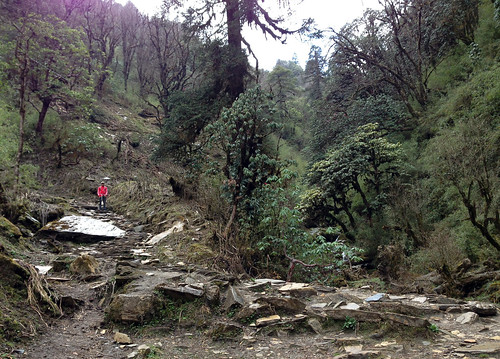
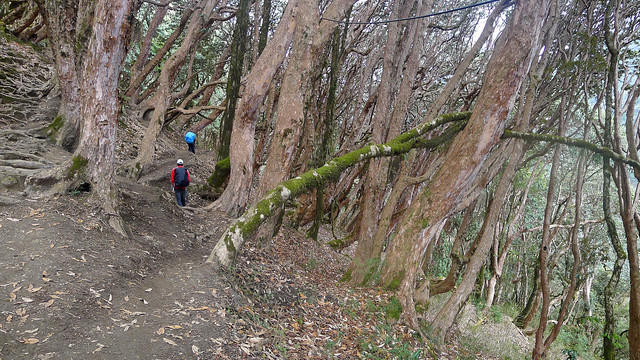
After that climb, it was mostly a series of knee-battering, continuous descents that day. While many trekkers continued to rest on top of that hill, I was determined to press on. Told Madan I wanted to go ahead, and he acknowledged my wish with an approving smile.  He and Hari followed me from a considerable distance, which gave me enough space; it felt good to walk ahead of everyone else and have some semblance of solitude as I made some pretty painful descents on the rough trail.

Made it to Tadapani at 3:00 pm; I was so pleased to have been right on schedule that I felt nearly redeemed from the misery that was Day 2.  Tadapani is a quieter settlement than Ghorepani. Had time to relax, write my notes, charge my phone for Rs 100, go on unlimited Wi-Fi for Rs 200--and take a shower only for Rs 100!  The low prices were unbelievable, considering how everything in the Everest region cost thrice as much. 


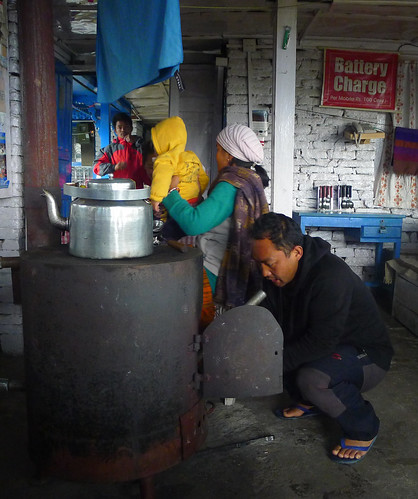
Teahouse owner warming up the stove inside the dining hall
My teahouse is called Super View and lives up to its name. It has some fantastic views of South Annapurna, Hinchuli and Macchapuchhre--the sight of which did not make me that sad anymore for missing out on Poon Hill. 

I sat in one corner of the teahouse's dining hall right beside the stove, and watched as the owner started to light the fire. The sun hadn't even set and it was already very cold. It was going to be a chilly night, and I didn't intend to give up my spot near the stove (which, incidentally, happened to have the best Wi-Fi signal).

When I finally went online, I was surprised to get what seemed like a hundred notifications from people on Facebook, Viber, Instagram, etc. I heard on that same day that an avalanche had occurred above Everest Base Camp and that more than a dozen Sherpas were killed somewhere in the Khumbu Icefall area while they were preparing the ropes and ladders for that season's Everest summit expedition.

Before I went online, I had no idea that people back home were freaking out over my safety. Most of them didn't have a clue where Annapurna was, and assumed I was just a stone's throw away from Everest Base Camp when the avalanche happened.

Hello. I mean, really.

I suppose I can never really convince people like my sisters (who don't make it a point to know their geography) to go check the distance between Annapurna and Everest so that they can realize that these are two separate regions. But it was sweet to get messages from everyone anyway; I just had to spend considerable time answering all the messages to assure everyone I was alive.  I was in good hands with Madan and Hari, and there was always Naba of Himalayan Planet Adventures in Kathmandu who knew what to do and had a copy of my travel insurance policy should things go wrong.

I was horrified over what happened to those poor Sherpas.  Because I had done the Everest Base Camp trek last year, the Khumbu region was indeed very close to my heart. Sherpas are one of the most hard-working, nicest people I know, and they are the true, unsung heroes in every Everest expedition. All those ropes that Everest summit climbers use from base camp to the summit were prepared in advance by Sherpas, and the latter certainly put their lives on the line year after year to ensure everyone else's safety. When I think of words like bravery, dedication and true grit, these are words that come to life in the form of Sherpas hailing from the Everest region.

The avalanche was the topic of the night over dinner in Tadapani. The locals were discussing amongst themselves if they knew any of the Sherpas who had died from the disaster. I still didn't have much of an appetite, but the garlic soup and the several forkfuls I had of garlic cheese macaroni were comforting. I felt like I had done well that day, and could only hope for the best in tomorrow's trek.      

One of my favorite forest trails on the way to Tadapani. Hari and Madan right ahead of me.

* * *

If you want to do an Annapurna Base Camp trek, do consider visiting the Himalayan Planet Adventures website and check out their 16-day Annapurna Base Camp trek package.


05 June 2014

Annapurna Base Camp Trek - Day 2: Trekking up the Ulleri Steps to Ghorepani

To read all posts on my Annapurna Base Camp trek, click here for the complete series.

Day 2 of the Annapurna Base Camp Trek - the forest trail in the afternoon
Day 2. Madan (left) and Hari (right) chillaxin' while I take photos. We had to pass through this dense forest in the afternoon.

Day 2: April 18, 2014

Horrible day. Just horrible. With a lot of drama and public displays of grumpiness from my end. Why does Day 2 of a trek always have to be a miserable one?

If you've been following my (mis)adventures on this blog, you'll know that the second day of my Everest Base Camp trek was an unforgettable ordeal--and this year's trek to Annapurna Base Camp just had to follow the same pattern. You know...the kind of hiking pattern that does cruel tricks to the mind and ego: an easy peasy Day 1 to make you feel good about your supposedly mad trekking skillz and then--kablam!--Day 2 throws you a sadistic punch to the stomach and leaves you in near-tears.

I totally blame the mountain trail, of course. And to a certain degree, myself--for being quite unprepared and not reading up more on the infamous Ulleri steps.

Day 2 of the Annapurna Base Camp trek - crossing suspension bridges
The day started nicely enough with a few
suspension bridges along the way. Then things
got rough quickly...
We were out on the path by 8:00 am, and my guide Madan informed me that it would take 2 hours in the morning to finish the steep ascent from Tikkedhunga (1,577 m) to Ulleri (1,960 m). And another 3-4 hours more until we reach Ghorepani at 2,850 meters above sea level by the end of the day. Great, I can do this, I told myself.

Well, see, here's the problem:  I should have remembered (as early as last year's EBC trek, for heaven's sake) that the Nepalis are like super human beings; think of them as a whole nation of agile Legolas-like entities who seem to have been born with a natural speed up on the mountains. What seems like *just* a 2-hour steep ascent to them may not necessarily be the same thing for us regular folks who find it harder to defy the laws of gravity.

I spent 4 hours that morning climbing up, up, up a sadistic, never-ending flight of steep rocky steps. It was like doing the StairMaster beside a ravine for 4 straight hours in the heat of the sun. Actually, to put things into better perspective, the total ascent to Ulleri was like going up the Empire State Building practically twice. From street level to the 103rd floor, the Empire State has around 1,870 steps. The stone stairs from Tikkedhunga to Ulleri is comprised of 3,210 steps; some say it's about 3,480. Try doing all those steps at an altitude level that's three to four times higher than that of the Empire State Building.  Just thinking about it all right now makes me want to hurl.

I kept moaning and groaning during those 4 hours, finding excuses to stop every 30 steps and guzzle down my water supply. Madan, who was used to my moods, knew how to take everything in stride.  I must have looked like a total drama queen to my porter Hari, though. He was always gently advising me to take it easy. "Bistaari, bistaari ('go slow, go slow')," he would say--before sprinting up the steps with my 10-kilo rucksack on his back. And in my mind, I was sobbing out, "Yes, unfortunately, Hari, that's exactly what I'm doing."

P1220383
I don't have photos of the steeper parts of the Ulleri trail,
which is composed of more than 3,200 steps.  This was
taken during the 'easier' bits.
Wasn't able to take many photos on the Ulleri trail because I was frequently looking down at the steps, watching my balance, and trying my best to survive the ordeal and to avoid fainting from the overpowering stench of animal dung. Dung everywhere. The smell was so strong, I felt my clothes reeked of dung for several hours.

To make myself marinate in self-pity even more, I watched taller, younger trekkers pass me by. The path itself was steep, yes, but the actual steps were also tall to begin with, and so it was all an extra struggle for me. Short-legged petite me was at such a natural disadvantage. The one prayer that kept running through my head was, please God, do play fair and let me lose at least 5 pounds on this literally shitty trail alone.

I wanted to burst into tears of relief when we finally reached Banthanti (2,250 m) for lunch. Because this was such a popular lunch stop, the locals at the teahouses were very busy cooking for everyone, and it took some time before my food (vegetable fried rice) was served. I was ravenous; that was the only time during the entire 9-day trek that I actually wiped my plate clean.

The trail after lunch was, blessedly enough, a 3-hour mix of flat terrain, gradual inclines and steep ascents. I mean, after that morning of Day 2, everything else felt easier. The Ulleri experience just completely stole the 'Worst Day Ever' Award from my EBC Trek Day 2, which was basically a 9-hour trek to Namche Bazaar in the pouring monsoon rain.

As we headed closer to the day's destination, I was feeling sick at the realization that Ghorepani stood at an elevation of 2,850 meters. That meant, from Tikkedhunga's height of 1,577 meters, I had made a total ascent gain of 1,273 meters on this day alone. It was obviously not your regular trekking day. I've never even covered that much in a day's trek on the Everest Base Camp trail.

<a href=
Donkeys on the trail
I reached Ghorepani, shivering slightly; the hot day had given way to a very chilly afternoon, and I was nursing a small cold as I hiked up. Ghorepani is like a smaller version of Namche Bazaar with many locals settled here eking out a simple living, while trekkers use this main stop to relax and prepare for the tough trail ahead of them.

Every trekker in the teahouse looked worn out and was sharing his or her own tale of woe on the Ulleri trail while drying socks by the stove (where everyone gathers, as this is the warmest place in every teahouse). Personally, I must have looked disgruntled and robbed of all happiness.

I don't think I was very good company that evening for Madan and Hari, who didn't seem to have lost their appetites.  I was so tired, I only had a few forkfuls of my tomato-onion-cheese macaroni dinner; Madan ended up eating the rest of the dish. Hot shower was actually free, but my exhaustion level was off the charts and all I wanted was to crawl into bed and pray that I would make it to Poon Hill (3,210 m) by sunrise tomorrow, still in one piece.

Day of Annapurna Base Camp trek - from Tikkedhunga to Ghorepani
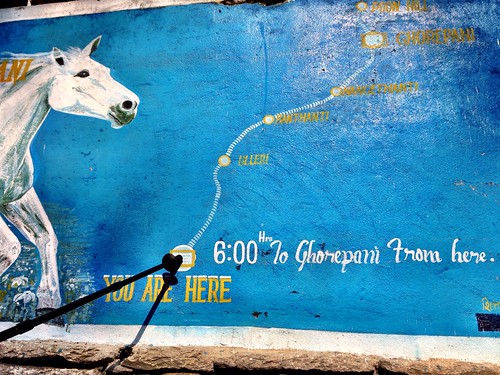
Six hours from Tikkedhunga to Ghorepani? You lie, you signboard you! Kidding aside, I honestly couldn't
do it in six. 
P.S. I write this post today, June 5. This, too, is a very special day for me. Not only is it my birthday today, but it was the same day I reached Everest Base Camp just a year ago.  Within the past 12 months, I feel like my two treks in Nepal have helped me grow so much as a person. These experiences have allowed me to revel in whatever strengths I have and have taught me to accept my limitations as well. It's been an awesome year. Hope there are more to come. :)
* * *

If you want to do an Annapurna Base Camp trek, do consider visiting the Himalayan Planet Adventures website and check out their 16-day Annapurna Base Camp trek package.


29 May 2014

Annapurna Base Camp Trek - Day 1: Trek to Tikkedhunga

To read all posts on my Annapurna Base Camp trek, click here for the complete series.

Annapurna Base Camp
Annapurna Base Camp. Elevation: 4,130 meters (13,550 feet) above sea level. Photo by Gina Sales, April 2014.

It must have been the cold and fatigue talking, but when I reached Everest Base Camp last year on the 5th of June (my 33rd birthday, to be exact), I muttered to myself that I didn't need to see another mountain again for a very, very long time. At that moment, I was tired as hell, breathless, and dealing with a sunburn and a pounding headache.

But the Himalayas is like a black hole: once you get sucked into it, escape is well nigh impossible---and a second trek is highly probable. Every trekker who's been to Nepal understands the lure of this mighty mountain range.

Six evenings after reaching Everest Base Camp, I was back in Kathmandu having my farewell dinner in Rum Doodle with Naba, the co-owner and managing director of Himalayan Planet Adventures. Over fish and chips, I found myself asking the all-important question: "So, where can I trek next?"

"Annapurna Base Camp."  That was Naba's swift reply and that became my obsession in the following months. I was ready to return to Nepal in 2014 after all.

As early as January 2014, I worked with Naba on an itinerary that aligned with my busy work schedule. I had a route map of ABC on my office desk to keep me inspired every day. I counted the days leading to my April 15 arrival in Kathmandu. I ran, I did yoga, I told myself I was primed and ready.  I thought, oh, I've achieved EBC.  I mean, how hard can ABC be after that, right?

Wrong.

As I was to discover throughout my 9-day trek, Annapurna Base Camp proved to be just as tough and challenging as Everest Base Camp. Sure, it was lower than EBC with only an elevation of 4,130 m (13,550 ft) as the end goal. I didn't realize that terrain was going to play a major factor in testing my endurance in this trek.

To keep to a modest budget for ABC, I opted to take a 7-hour bus ride from Kathmandu to Pokhara and back, instead of taking the plane. The ride wasn't a total ordeal, as I chose to go via Greenline, which is like one of the country's premier tourist bus services with a good safety record. Buffet lunch was part of the package, I had good spacious seats, and there were adequate toilet stops. In short, I was a happy camper. After the recent Nepal Airlines plane crash that killed 18 people heading from Pokhara to Jumla, I wasn't keen on taking a domestic flight anytime soon. I still get the shivers every time I think of my flight from Kathmandu to Lukla in the Everest region.

The classic route to Annapurna Base Camp usually starts with an overnight in Pokhara, a lovely bustling tourist town that serves as the jump-off point for the trek.  I got to rest well and sort out my gear in the hotel while bonding with my companions.  I made sure from the very start of the trip planning process that Madan, my guide to Everest Base Camp last year, would be with me again on this trek. My porter was Hari--who I found out later on is actually Madan's elder brother. With the two brothers watching over me, I knew I was in good hands.


Day 1: April 17, 2014

Started the day right with a big breakfast at my Pokhara hotel. We were out by 8:00 am and on a 1.5-hour ride via private car to Nayapul, where the trek officially begins. There was enough time for a quick snack of spicy vegetable curry and coffee (what a combination) at a Nayapul roadside canteen before hitting the trail at 10:30 am.

edited_IMG_7812
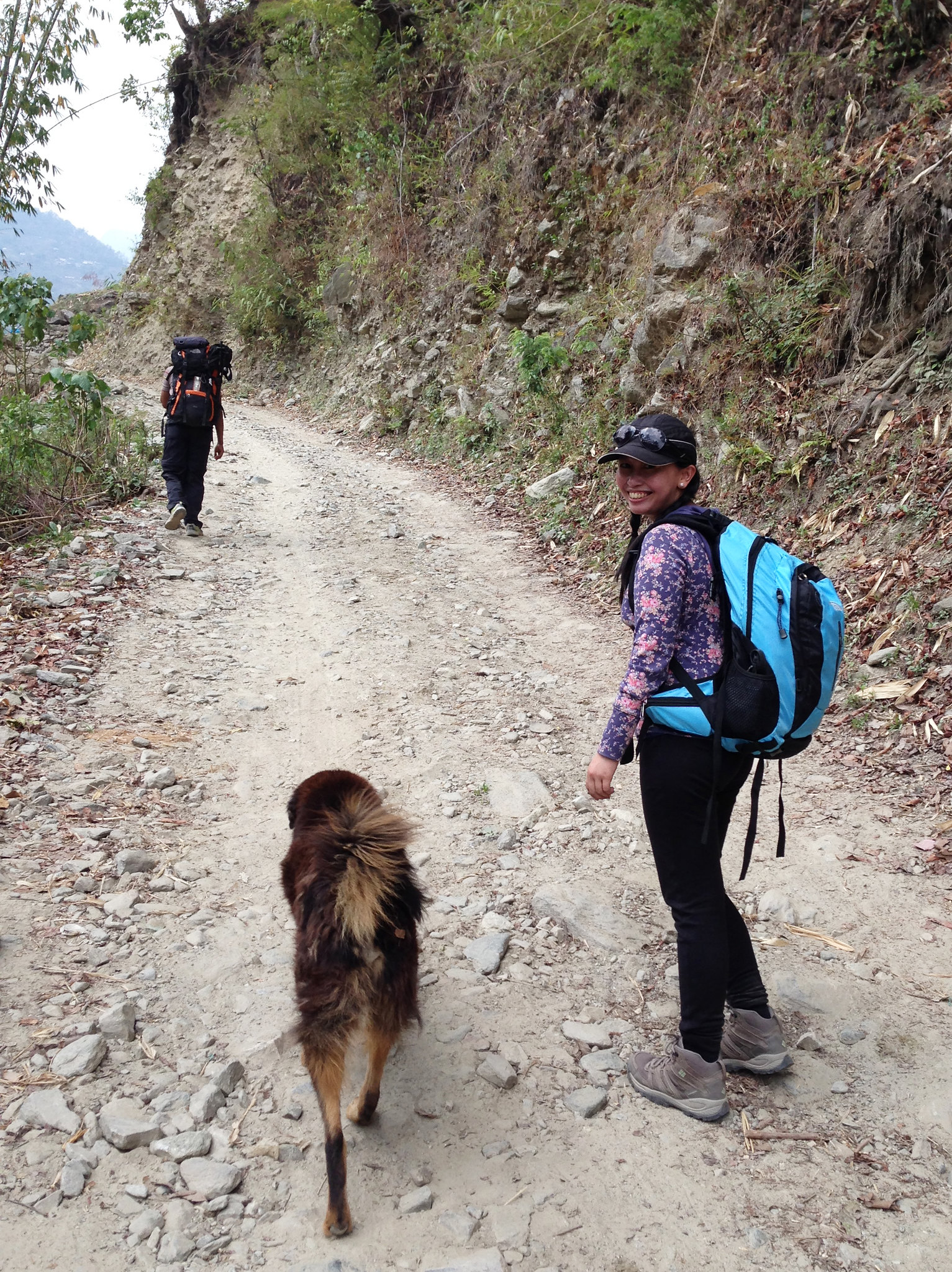
Day 1. This dog walked beside me for quite a while on
the trail. My porter Hari was just a few meters ahead.
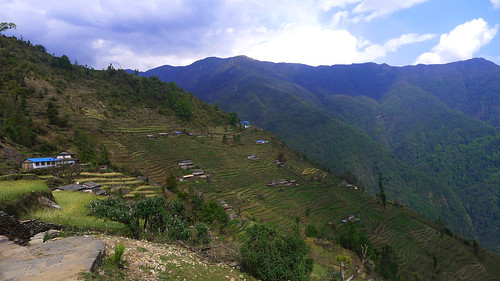
I was awash in a nice warm sensation of being at home as I started my walk on the trail with Madan and Hari. It felt like being on the EBC trek all over again; the only difference here was that the altitude level was a lot kinder since we were starting at a height of only 1,070 meters above sea level.

(Side note: As I write this first blog entry on Annapurna Base Camp, I realize that today's date is May 29--a very special day.  It is the 61st anniversary of Hillary and Tenzing's historic ascent to Mt. Everest's summit, and it falls on the same day that I started my Everest Base Camp trek last year. Perhaps I was meant to write this blog post on this auspicious date after all.)

As we were still at a lower elevation, it was a hot and humid day. Nothing exciting really happened since the first day was pretty much peanuts--4 hours of trekking on relatively flat terrain plus lunch hour. Since I was doing the trek in spring time, that meant significant 'trekking traffic' on the road.  Last year, I practically had the Everest trail all to myself during monsoon season.  This year promised to be different.

I encountered many American, Canadian and European trekkers. Didn't get to see any Filipinos on the ABC trail (which made me feel a wee bit lonely), but there were a lot of Chinese and a handful of Thais, Koreans and Indians. Yup, the Philippines was sadly underrepresented. And it didn't help that I kept being mistaken for a Thai or Japanese national.

Reached my Tikkedhunga teahouse at 2:30 pm--just in time to settle down before a particularly heavy rainstorm started. Whether it was spring time or monsoon season, I already had a fair amount of Himalayan trekking experience to know that one had to be prepared for any kind of weather up in the mountains.

Had potato cheese momos and hot chocolate (as in really good hot chocolate) for dinner and then I hit the sack at 9:00 pm. I knew we were going to do some tough trekking the next day, and I certainly needed rest in preparation for that.

* * *

If you want to do an Annapurna Base Camp trek, do consider visiting the Himalayan Planet Adventures website and check out their 16-day Annapurna Base Camp trek package.


30 September 2013

Tips on How to Prepare for the Everest Base Camp Trek

To read all posts on my Everest Base Camp trek, click here for the complete series.


Seeing this map makes me realize how far I've trekked--from Lukla all the way to Everest Base Camp.
Oh my God. Image Credit: Himalayan Planet Adventures P. Ltd.

A lot of people have been asking me how I prepared for Everest Base Camp, what stuff did I bring, what life was like on the trail, etc.  Someone even asked me if I had to ration my food for 12 days and cook my meals over a campfire every night. Lol.

This blog post is written for those who are doing this trek for the very first time and wish to know what to expect. I've also made a previous post on a breakdown of all expenses during an Everest Base Camp trek as well as another blog entry on a complete packing list for trekkers to EBC.

I wrote all these because I wanted to share my experiences, and hopefully help somebody in preparing for this once-in-a-lifetime trek. And if this blog post does convince someone to go and do it, that would make me very happy!

1. Go solo or go with a group or buddy?  Trek costs can be shared between friends and/or couples, especially when it comes to food, lodgings or a nice pot of piping hot chocolate. Plus, you're bound to take each other's photos the whole way going up, so there won't be any shortage of captured memories. Just be sure your trekking buddy is someone you really get along with--because you'll be stuck with one another 24/7. Joining a group can also be arranged prior to the trek. If you are hiring a local trekking agency, they normally group you with others who are scheduled to trek on the same day as you are. You can also arrange with the agency for you and your buddy to trek as a private group. Or, you can always go on those Lonely Planet and Trip Advisor forums where people are looking for fellow trekkers to trek with them on specific two- or three-week periods.

I traveled solo, and I loved every minute of it. There is absolutely no reason for anyone--especially for solo female travelers out there--to be concerned about doing Everest Base Camp alone. First of all, you aren't really alone. There's a guide and porter with you, and at the end of each day, you get to meet fellow trekkers in the teahouse you're staying in for the night.  The trail is full of people, especially during peak season. However, independent trekkers are normally discouraged to travel completely alone; in the event that one needs medical assistance, someone may not be readily on hand to answer the call for help.

The advantage of traveling solo is that I got to do everything at my own pace.  I didn't have to deal with the pressure of keeping pace with total strangers, who may be impatient and way faster than me, or may be super slow. Or they may be the type to complain a lot, talk too much, exhibit annoying characteristics, etc. If I had happened to get stuck with people I didn't really like, then I would have had no choice but to spend 12 full days in their company.

When I craved solitude, I got to have my 'alone' time. When I felt like chatting with people, I'd talk to other trekkers in the teahouse or I'd strike up a conversation with a stranger on the trail. Most of the time, I talked and played cards with my guide and porter, and those were great bonding times. But whenever I felt the need to be alone, I had enough space and time to enjoy my solitude. Solo traveling is pretty fun as it puts you in control of all your travel arrangements.

in Tengboche on the Everest Base Camp trek by gina sales, on Flickr
I traveled solo--and my best friends on the trek were Dhan Kumar (left) and Madan (right), my porter and guide, respectively. This is my favorite picture of us in Tengboche. Everest is right behind us three.

2. Getting a local trekking agency vs. Do-It-Yourself. I didn't even include foreign trekking agencies (located outside Nepal) as an option. They are just too expensive. I mean, sorry, but what's the point of going through them? You can arrange the trek logistics yourself or search the Internet for credible trekking agencies in Nepal. There are plenty of them, and the Nepalis are honest people to deal with.

That said, once you decide to go DIY or through a local agency, this will pretty much spell out how your trip will look like. Decide between these 2 options, and everything else will follow.  It all depends on your comfort level, budget, and how you want to control things. For more information on what to budget for, visit my blog post on costs to expect during an Everest Base Camp trek.

Going DIY means hiring your own guide and/or porter and making your room and food arrangements as you go. Guides and/or porters can be hired the moment you land in Lukla. You will of course need to talk to them (and rely on your wits and gut instinct to see if you're comfortable enough to be with them for 12 days) prior to striking a deal. Most, if not all, of the Nepalis I've met along the trail are polite and friendly. Tourism is what drives the economy of the Khumbu region where Everest is, and trekkers are treated with great hospitality.

I opted to get a local trekking agency, Himalayan Planet Adventures (HPA), and I chose their 16-day Everest Base Camp trek package. While getting an agency may be rather pricier than trekking independently, I felt it suited my budget and my idea of how I wanted my trip to be. I didn't want to deal with the hassle of looking for a guide and porter, securing my own domestic flights, choosing a teahouse at the end of each day, and reaching for my wallet after every meal I ate.
When I arrived in Kathmandu, everything was conveniently arranged for me; I just paid for the full package cost--which included my hotel in Kathmandu, teahouse lodgings, food, guide and porter fees, permits, domestic flights, and airport transfers. With this package, I could pick any food item on the menu in any teahouse I was in, and I could also have my choice of hot drink with each meal plus a bowl of soup a day. I didn't have to worry about carrying loads of cash (or losing all that cash!), because my guide Madan took care of the lodging and food arrangements in my behalf. All I had to shell out personally as miscellaneous expenses were mineral water, hot showers, treats (like chocolate), battery charging and Wi-Fi.

When I was stuck in Lukla for a day before heading out to Kathmandu, the HPA team was the one arranging for my revised domestic flight bookings and a possible chopper ride. For me, it was all about leaving the nitty-gritty logistics to the agency so that I could fully focus on the physical demands of the trek.

Again, it all depends on your budget and the level of comfort and control you're expecting on the trail.  It's your Everest Base Camp trek, so feel free to choose whichever option makes you happy.


3. Physical Conditioning. Obviously, you have to be decently fit for this trek. You don't need to be ultra athletic (I'm most definitely not!); just make sure you have had some form of physical preparation a few months before EBC. Some trekkers do conditioning for an entire year prior to the trek. If you do regular exercise, you'll be fine. I do running, boxing and bikram yoga (hot yoga) during my spare time. When I was preparing 3 months before Base Camp, I just merely had to increase the rounds I'd do for boxing, or run a few more extra kilometers as endurance training. I've been doing bikram yoga for two years now, and I've realized that all those breathing exercises at the start of each bikram session really helped me during the hardest days of the trek.   


vegetarian food on the Everest Base Camp trek
I'm not the best in taking food photos, but this
tomato garlic pasta with yak cheese tastes so good!
Fresh or  dried chili is always available if you like
your food spicy like I do.
4. Going Vegetarian for 12 Days. It's not like you have much of a choice, actually. Be gastronomically prepared to go vegetarian all throughout the trek. There is no frozen storage system in the Khumbu region, and all uncooked meat are carried up and down by Sherpas. The freshness of the meat can't be guaranteed. So if you have a sensitive stomach or if you don't want to risk acquiring some gastrointestinal illness, avoid meat altogether while you're on the trek. My guide Madan said I could have meat at Namche Bazaar or at lower elevations, so if you are really craving a burger or meat pizza, you can have those at lower altitude levels.

I played it safe and avoided meat completely. I thought I would be weak for the whole 12 days but I felt surprisingly healthy and strong. The Sherpas at the teahouses can really cook up a storm, and they serve really delicious veggie dishes like garlic cheese pasta and vegetable rice. And then there is the ubiquitous staple meal of the Nepalis which they can eat day in, day out and never get tired of--dal bhat. It is a dish that is composed of rice (bhat) and cooked lentil soup (dal) that is most often supplemented by vegetables, potato curry, pickled chili, and sometimes with roti or papadum.

I would sometimes find myself looking forward to a steaming hot plate of dal bhat at the end of a cold, wet day of trekking. The best part is, the Nepalis always serve you more than one round of dal bhat if you're in the mood for seconds or thirds.

dal bhat on the Everest Base Camp trek
I think dal bhat is the reason why Nepalis are so strong and can carry truckloads of stuff on their backs. As my
porter Dhan Kumar would say, "Dal bhat power, 24 hours!"

5. Bring cash. I kind of learned this the hard way.  Before the trek, I made sure to withdraw enough money from an ATM in Thamel, Kathmandu, because I read somewhere that there would not be any ATMs to be found up on the trail (for very obvious reasons). No credit card machines either past Namche, of course.  So make sure you have Nepalese Rupees with you before you fly to Lukla. This is so important. When I got back from the trek, I was kind of running low on cash and I wanted to withdraw money, especially when I was stuck for an extra day in Lukla.  No ATM machines there, but you could ask your guide to bring you to a few banks in Lukla that can swipe your credit card for you, and then they will provide you with the cash equivalent.  Thankfully, I didn't have to do that, as I was able to fly to Kathmandu the next day.


Dhan Kumar and the yak stove
Dhan Kumar places dried yak dung into the stove. Yak dung
is used as fuel everywhere in the Khumbu region to keep
people warm by the stove at night. 
6. Expect basic accommodations. This is a trek to Everest Base Camp, after all, so best to lower your expectations.  Frankly speaking, roughing it during the trek is really part of the charm, and I was glad to go through such an experience. Teahouses (which are like small, more basic-looking Swiss chalets) along the trail normally offer rooms that contain two single beds each, common toilets (some have common shower facilities), a big common dining area where everyone gathers--and zero central heating system. Well, there's the stove in the middle of the dining hall that's basically the warmest place in the entire teahouse--but it's only lit for a few hours every evening.

Toilets are usually the squat kind, but many teahouses have at least one Western toilet. As for showers, you can encounter either a 'bucket shower' or a 'gas shower' in some teahouses. Read about my bucket shower experience if you're the type who needs to have at least one or two showers during the entire trek.

Rooms get smaller the higher you go up, but are decent enough, if you're not the fussy type. All rooms have pillows and blankets, and you could always request for extra, when it's low season. Come peak season, you will need to depend on your sleeping bag and just one blanket to keep you warm--as teahouses can really fill up fast with trekkers.  Trekkers who aren't able to get a room end up sleeping in the dining hall.

Most teahouses at higher elevations are powered by solar electricity; there are times when you are unable to charge your phone or camera at all because there is no electricity.  So when you are in a teahouse that does have electricity, do grab the opportunity to charge your gadgets. You wouldn't want to run out of batt when you get to Base Camp.

a typical teahouse dining hall found on the Everest Base Camp trek
A typical teahouse dining hall (with a stove in the middle) found throughout the Everest trail.

A Sherpa man and his heavy load on the Everest Base Camp trail
A Sherpa carries his heavy load up the trail. It's just a
typical day's work for them, but it's so mind-boggling
to see so many of them do this all the time. Super humans!
7. Give way to Sherpas and yaks. Try and compete for space on the narrow trail path with a yak--and chances are, you'll be injured by its sharp horns, or worse, you may get nudged off the cliff. When a train of yaks is arriving, you need to stop trekking, step aside, and practically press yourself against the mountain wall to avoid being a yak victim.

As for Sherpas, you can't help but respect them and give them the right of way-especially when they're carrying thick stacks of plywood on their backs or heavy drums filled with goods.  The people of the Khumbu region are impressively strong, but they're human, too. When you encounter them on the trail carrying heavy loads, give them a break by not blocking their path. The reason you have a roof over your head and a decent bed to sleep in on the remote trails of the Himalayas is because Sherpas carried all those construction materials on their backs up to the top.


8. Respect the local culture. Be mindful of local customs, and when your guide tells you to always walk on the left side of a prayer wheel or a Buddhist Mani stone wall, or turn the prayer wheel in a certain direction, just do so.  And it doesn't hurt to learn the local language either. Basic phrases like 'namaste' (hello/goodbye-which is also said a lot in my yoga classes) and 'dhanyabad' (thank you) are commonly exchanged between the locals and trekkers alike. I have an affinity for learning new languages so I asked Madan and Dhan Kumar to teach me as much Nepali as they could. I had them laughing in stitches every time I'd say something funny (or naughty) in Nepali, which is a nice language to learn.
Buddhist mani stone and prayer wheel along the Everest Base Camp trail
Always turn the prayer wheel in a clockwise direction.
And always walk on the left side of a Buddhist Mani
stone.

When you see Sherpas carrying their heavy load or are at rest on the trail, just say, 'Namaste. Ke cha?' Then watch them break into smiles. 

To be honest though, I think the one local thing I had difficulty accepting was that guests are served their food first, and guides/porters have to wait at least 30 minutes or an hour after for them to receive their food. It is understandable that Nepalese would want to consider their guests as first priority, but as a trekker traveling with both her guide and porter, I felt uncomfortable being served food while my two companions, who were equally tired and hungry as I was, had to wait some more. In my country, regardless of social or economic status, food is served to everyone at the same time and people normally eat together. 

But the Nepalese teahouse owners were pretty nice about my requests to have Madan's, Dhan Kumar's and my food served together. They were a little surprised about such requests, but very obliging. 

9. Buy all you need in Thamel, Lukla or in Namche. If you've forgotten to get some trekking gear in your own country, you can do last-minute shopping in the bustling backpacker district of Thamel, Kathmandu, the best place to be in for all your trekking needs. Lukla has a lot of shops too, but with lesser choices compared to Kathmandu. 

As for Namche Bazaar, think of it as the Rivendell of your trek.  It is the last point of civilization as you know it. Goods become scarcer and way too pricier as you ascend past Namche.  So if you need to buy trekking gear, hand sanitizer, energy bars, multivitamins or even a deck of playing cards, Namche Bazaar is your last chance to do so.   


10. Counter Altitude Sickness. Last, but certainly not the least! Acute mountain sickness (AMS), or commonly referred to as altitude sickness, is, I think, the great equalizer when it comes to trekking. Regardless of fitness level, age and even mountaineering experience, everyone is bound to feel AMS at some point past the 3,000 meter mark.  It just depends on the degree of altitude sickness that you've contracted. Altitude sickness is no joke, and can even lead to death. On the day I was to reach Base Camp, I learned about the deaths of two trekkers who never made it due to altitude sickness.

Mild AMS is normal and is experienced by many.  But severe AMS is debilitating, and any person with moderate to severe AMS should already be given the medical attention needed.  Under such cases, the trekker experiencing bad altitude sickness is already made to descend as rapidly as possible before it becomes fatal.

Mild symptoms include headache, fatigue, breathlessness, and loss of appetite--all of which I experienced at some stages and which were addressed immediately.  You know you already have severe AMS if you're experiencing severe headache, disorientation, vomiting, breathlessness (even at a standstill) or if you're exhibiting irrational behavior. If these symptoms are happening at the same time or one after the other, you need to descend immediately or have your guide arrange for a helicopter evacuation, weather permitting.

Here's how to avoid severe altitude sickness:

a. Proper Acclimatization - I talked about acclimatization in this post, as explained to me by Naba and Madan of Himalayan Planet Adventures. The general rule is to 'climb high, sleep low.'  And for about every 1,000 meters of ascent, you will be asked to stay an extra day at that current level in order for your body to adjust and acclimatize.  Your guide should be able to advise you on this. And please do not trek completely alone. Who's going to guide you down the path when you have a massive headache, and you're retching and feeling dizzy and disoriented? When I was experiencing minor AMS on the way to Pangboche on Day 4, Madan and Dhan Kumar were there to help me and monitor my condition.

garlic soup on the Everest Base Camp trail
A bowl of garlic soup a day keeps the altitude sickness away.
I had one every night while on the trail. 
b. Drink 3-4 liters of liquids a day - Because of the demands of the trek, you will easily consume at least 2-3 liters of water a day. Never allow yourself to be dehydrated, as this helps contribute to AMS. Liquids such as hot chocolate and garlic soup also helped me a lot; garlic soup is a natural preventive method against AMS and is pretty delicious.  Coffee and too much tea are actually not recommended during the trek, as these cause heart palpitations. As much as I am fond of coffee, I had to stop around Day 3.

c. Take Diamox - Diamox (generic name: Acetazolamide) is the medicine one takes to counter the effects of altitude sickness. On the Internet, there are differing opinions as to when to take it--whether to start taking it 24 hours before the trek or to take it when you start feeling symptoms, or to simply avoid it at all. My advice: consult a doctor prior to the trek. Diamox can affect people in different ways. In my case, I only took Diamox when I started contracting minor altitude sickness, which was in Day 4 of the trek. My daily dosage was 250mg--split into two, so I could take 125mg in the morning and 125mg in the evening. You can buy Acetazolamide in Kathmandu or in your own country. In the Philippines, it is known as Cetamid. Some typical side effects of Diamox include frequent peeing and a tingling sensation on your toes and fingertips.

d. Pace yourself - I honestly don't get why some trekkers feel pressured into going up to Everest Base Camp as fast as they can. This isn't a race. Nobody back home would really care about your pace per day or if you outpaced your trekmates; they just want you safe and alive. I hear and read sad stories about how there are ultra-fit, super competitive people who trekked to EBC only to descend because their bodies couldn't handle it, that they didn't acclimatize properly, that they overexerted themselves, etc.  In some cases, trekking with a group even presents dangers, as people have different stride lengths, endurance levels, and pacing--and all this makes some feel 'pressured' into keeping up with the overall pace of the group.

e. Avoid alcoholic beverages and cigarettes during the trek - You do not want a hangover to enhance your experience of altitude sickness. You really do not. And breathing the thin air through the nose or mouth is already a hard task; you won't be able to smoke properly anyway. Reserve the liquor and tobacco for your last day, when you're back in Lukla.      


Sorry for the long post, but that's pretty much it! All the important stuff to know before heading off for the Everest Base Camp trek. This is my last post on Everest Base Camp (whew!) and I hope you found something useful or at least mildly entertaining in all the 10 or so posts I've written.  The grandeur of the Himalayas has inspired me so much that I'm actually planning my next trekking trip to Nepal. I won't say yet where in Nepal exactly I'm going but I hope to update you on that one of these days. :)

acclimatizing in Dingboche on the Everest Base Camp trail
Hello, goodbye, and see you again soon, Nepal!


09 September 2013

Packing List for Everest Base Camp Trek

To read all posts on my Everest Base Camp trek, click here for the complete series.


packing for Everest Base Camp
Some of my trekking stuff on my hotel bed in Kathmandu.
So--what to pack for the standard 12-day Everest Base Camp trek?

It's a pretty long list, but when you assemble everything into one bag, you'd realize eventually that everything on that list is quite essential. Be ready to carry everything on your back for 12 days--or if you're like me, hire a porter to carry 15 kilos of your stuff while you bring a day pack for all your essentials.

The key to staying comfortable all throughout the trek is to wear your clothes in layers.  For bitingly cold weather, expect to have 4-5 layers on you.  But in lower levels where it's hot and you get to work up a bit of a sweat, you must be able to easily strip off your fleece or outer layers.

My trek agency Himalayan Planet Adventures helped me a lot by sending a list of suggested clothing and equipment to bring, but I've also added some items which I think are useful. Unless indicated otherwise, all the stuff listed here are items I really brought with me on the trail.

Note: Some of the stuff here can be bought last-minute in Thamel, Kathmandu before your trek--such as the headlamp, trekking poles and even fleece jackets and such. You can even restock on toiletries and other sundries in Kathmandu, Lukla or Namche Bazaar. Will discuss this more in my very last post on this Everest Base Camp trek series.


Trekking Clothes

Head
  • cap / sun hat - Ideal for the first few days and the last days of the trek when you're at lower altitude levels and it isn't so cold. I forgot to bring one, which was quite silly of me. 
  • wool/fleece hat - to keep your head and your ears warm as you ascend to higher, colder terrain
  • face scarf - I wish I had brought one! You will need it to keep out dust and the cold wind. Plus, it will help keep your nose (and any other unprotected part of your face) from being sunburned. 
  • neck scarf
  • sunglasses

Upper Body
  • 2-3 quick-dry long-sleeved tops - Use 2 for the entire trek and keep an extra one for indoor use
  • 1 sweater - I used this for indoors
  • 2 fleece jackets - I used one for outdoors and one for indoors. Again, always have a complete, clean set of clothes to change into when you reach the teahouse. 
  • 1 waterproof shell jacket - I used a North Face tri-climate waterproof shell jacket which can be detached or separated from its inner fleece jacket layer. For trekking in humid monsoon weather, just remove the fleece jacket and wear the outershell waterproof one.
  • 1 down jacket - My trek agency provided me with one, although I ended up not using it, since it was too warm to wear it in May/June. But bring one for the colder trekking months.
  • thermal underwear or base layer - You can buy those pricey base layers from Columbia or North Face, but my Uniqlo and Debenhams thermal wear kept me wonderfully warm


Lower Body
  • 1 pair of lightweight thermal leggings - These may be too hot to wear under your hiking pants on the first few days but will be useful as you head nearer to Everest Base Camp.
  • 2 pairs of trekking pants - Have a lightweight one for most days and another one that's waterproof (outer shell pants)
  • 1 pair of fleece pants - For indoor use and for sleeping.  I cannot stress enough the importance of having 1 clean pair of pants to change into when you reach the teahouse after a hard day's trek. 
  • disposable underwear - This one is really more for the females.  I know this isn't the most eco-friendly suggestion, but admit it--women feel a greater need to stay hygienic, especially when it comes to the sensitive nether regions. And because of the cold weather, you won't be able to launder your regular undies with soap and water since these won't dry in time. I wasn't really keen on wearing the same undies for two to three nights in a row (sorry, that's just roughing it way too much, at least for me), so I brought 10 pieces of disposable underwear with me, plus some regular undies. Every day, it felt great to change into clean underwear. I didn't see any other website that recommended bringing disposable underwear; I only saw several packs in my local Watson's store, and thought it would be a great idea to bring these on the trek. They're cheap, hygienic, lightweight, biodegradable, and disposable. Hurray! 

Hands
  • 1 pair of fleece gloves
  • 1 pair of waterproof gloves (although I never got to use them)

Feet
  • hiking boots - Your hiking boots are the most important thing in this trek, so do not forget to bring them. Invest on a good pair, or bring your reliable old ones. Do not assume you can buy boots in Kathmandu before the trek, as you may have a hard time looking for a pair that will suit you. I used mid-cut waterproof Columbia hiking boots which had great traction.
  • slippers / sandals / sneakers - For indoor use. Although I would recommend bringing slippers/sandals instead of sneakers to let your feet breathe a bit.
  • 3 pairs of warm trekking socks - For the colder months, bring more than 3 pairs. Use a clean pair when you sleep, so that your feet remain warm.


Trekking Gear
  • headlamp - very useful especially when you need to make your way to the toilet in the middle of the night when all lights are out
  • trekking poles - your lifesaver in the most difficult parts of the terrain, whether going up or down
  • day pack and/or back pack w/ pack cover - If you are hiring a porter to carry majority of your things, just carry a day pack with you that contains the essentials.  Your porter will not necessarily be with you all the time on the trail (as he may be going way ahead of you sometimes), so place in your day pack the things you need, like a water bottle, sun screen, money, camera, waterproof jacket, etc. Himalayan Planet Adventures provided me a duffel bag where I stuffed all the things I only needed at the end of the day.  And then my porter Dhan Kumar just carried the duffel bag.
  • 1-liter water bottle
  • extra batteries
  • sleeping bag with liner - Himalayan Planet Adventures lent me one but I didn't really need it apparently for the monsoon season. The thick blankets inside my teahouse room sufficed. But bring a sleeping bag for the colder months, and ensure that it can keep you warm in subzero weather.

Documents (keep all your documents protected in a ziploc bag; otherwise they will get wet!)
Clockwise, from L-R: My copy of Lonely Planet Nepal, a handy
journal and pen, a map of the Everest region, and my Kindle Touch
(I NEVER go anywhere without my Kindle). Naba of Himalayan
Planet Adventures gave me the map before I left for the trek.
I really love this map!
  • passport w/ Nepal visa
  • Trekkers' Information Management System (TIMS) card - I've discussed in this blog post more about the TIMS card, how much it costs and how to get one. If you've hired an agency, they will arrange to get this for you.
  • Sagarmatha Park entrance permit - Same as the TIMS card above. Check my blog post on how much it costs and how to get one.
  • map of Everest region (optional but pretty good to have)
  • extra copies of your passport photo (for your Nepal visa and TIMS card)
  • copy of your travel insurance policy
  • international flight e-ticket and domestic flight tickets (in case you need them as reference)
  • money - keep 'em safe and dry


Toiletries & Personal Hygiene Items

  • personal medical kit - should contain the following: Diamox to counter altitude sickness (even if you don't plan on taking it, just have some on standby in case you do need it!); pain relief medicine for headache/migraine; medicine for diarrhea; oral rehydration salts (optional but good to have); medicine for cold, cough, fever and flu; multivitamins; bandaids, bandages, other medicine you may need
  • water purification tablets / Steripen - I brought water purification tablets with me as an extra precaution but I opted to buy mineral water on the trail, even though this would cost me more. It all depends on each trekker's comfort level.  My personal reasoning is this: I spent so much money for this trek. And if I happen not to make it to Base Camp because my drinking water was not 100% sterilized and I've managed to contract diarrhea, I have only myself to blame.
  • standard bath toiletries, toothbrush & toothpaste
  • 1 to 2 large packs of baby wipes / anti-bacterial wipes - your ultimate best friend on the trek especially on those days when you can't take a bath
  • toilet paper & tissue paper
  • quick-dry bath towel and face towel - Don't bring the regular heavy bath towel, unless you want to deal with a soggy towel all throughout the trek. Those lightweight, quick-drying ones are the best.
  • sunblock - The higher you ascend, the more exposed you are to the sun, even if it's abysmally cold and the sun doesn't seem to be anywhere in sight. Avoid being sunburned. 
  • hand sanitizer / isopropyl alcohol - Sometimes there is no running water and soap in the teahouses for proper handwashing. You need to sanitize your hands to avoid diarrhea and other gastrointestinal problems.
  • lip balm and face moisturizer - Really important. The cold will really dry up your face and lips.
  • small comb and mirror 
  • deodorant


Other Travel Items
  • camera w/ charger and spare battery - It would be very tragic if you forgot this. 
  • books to read - Rather than carry a bunch of books, bring an e-book reader! I always travel with my Kindle and I get a lot of reading done in the airports, on the plane, and in the teahouses. 
  • guide book - Optional but still nice to have. I brought my printed copy of Lonely Planet Nepal as well as a Kindle version. That's how I roll.
  • small journal and pen - Even if you're not the type to write, a notebook will be handy to jot down your day-to-day notes or even your expenses on the trail.
  • energy bars / trail mix / chocolate - The stuff you need to keep yourself happy and energized on the trek
  • playing cards 
  • ziploc bags
  • medium or large clear plastic bags - Preferably the ones that are sold in rolls (10-20 plastic bags per roll). Compartmentalize all your stuff and place them into medium or large plastic bags. Have one plastic bag contain all your clean indoor teahouse clothes. Have one bag with your towel and bath toiletries, another for your dirty clothes, and another for your toiletries, etc.  At the end of each trekking day, you're quite exhausted and one of the last things you want to do is to keep rooting around in your bag, looking for all the stuff you need. Whenever I reach the teahouse, I'd easily be able to pull up whichever plastic bag I needed. This method saves me time, and I avoid having all my dirty and clean clothes mixed up. Biodegradable plastic bags are sold widely in groceries and supermarkets.
my room inside Namche Bazaar teahouse
Inside my nice, spacious room at the Namche Bazaar teahouse. I get a big bed--hooray. I'm usually a neat person, but
the trek left me so tired every day, that I'd end up placing my stuff everywhere! Sorry for the mess. 

* * *

If you want the same Everest Base Camp trek experience I had, visit Himalayan Planet Adventures and go for the 16-day Everest Base Camp trek package.